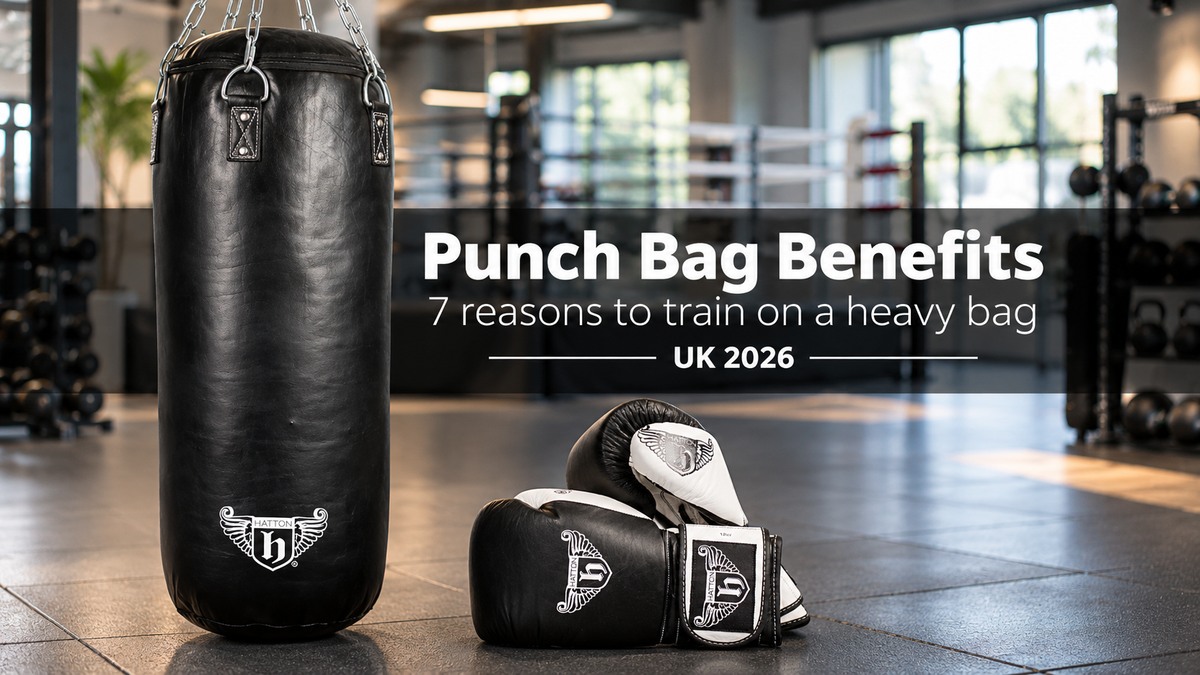

Punch Bag Benefits UK (2026): 7 Reasons to Train on a Heavy Bag

The main punch bag benefits are vigorous cardio, upper-body and core power endurance, sharper technique and coordination, and a hard, structured workout that puts no running impact through your knees. The size of each benefit depends on two things: how hard you work the rounds, and whether the bag gives you consistent resistance shot after shot.
The short answer: three or four sessions a week of timed rounds on a dense, well-filled heavy bag can meet the NHS weekly target for vigorous activity on their own. The Ricky Hatton Professional Boxing Heavy Duty Punch Bag (£174 – £312) is the bag we would choose to get those benefits at home, because its fill holds its shape under repeated heavy work.
Key takeaways
- Bag work is vigorous exercise: 7.0 METs at 60 punches a minute, rising to 10.8 METs at 180, in the 2024 Compendium of Physical Activities.
- Paced rounds push your heart hard: 83% of maximum heart rate at 180 punches a minute in a study of amateur boxers.
- Your hands take the load, not your knees. The hand is the most frequently injured body location in boxers, so gloves and technique come first.
- The bag decides the quality of the workout. Consistent fill means consistent resistance, round after round.
- 75 minutes a week of vigorous activity is the NHS target: about three sessions of eight three-minute rounds.
What are the main punch bag benefits?
Seven benefits come up again and again, and most of them are backed by measurable evidence. The table sets out what drives each one and what the research says.
| Benefit | What drives it | What the evidence says |
|---|---|---|
| Cardiovascular fitness | Continuous punching in timed rounds | 7.0–10.8 METs depending on punch rate (Compendium of Physical Activities) |
| Calorie burn | Whole-body work at high heart rate | Roughly 460–860 kcal an hour for an 80kg adult, by the Compendium's MET method |
| Power endurance | Hundreds of hip-driven punches per session | Repeated sub-maximal efforts against a heavy, resisting target |
| Technique and coordination | Combinations, footwork and timing against a moving bag | The bag returns resistance on every shot; shadow boxing cannot |
| Focus under fatigue | Three-minute rounds with short rests | Heart rate averaged 83% of maximum at 180 punches a minute (Arseneau et al., 2011) |
| Low lower-body impact | No running or jumping required | Load falls mainly on the hands and wrists (Loosemore et al., BJSM) |
| Training at home, on your schedule | A fixed station that is always set up | No travel time, so sessions fit around your day |
Is a punch bag good cardio?
Yes. Timed rounds on a heavy bag are vigorous cardiovascular exercise, and the intensity depends almost entirely on your punch rate.

The 2024 Adult Compendium of Physical Activities lists general punching-bag work at 5.8 METs. Paced work rises to 7.0 METs at 60 punches a minute, 8.5 METs at 120 and 10.8 METs at 180. For comparison, the same table puts boxing sparring at 7.8 METs.
Laboratory work backs this up. In a study by Arseneau, Mekary and Léger in the Journal of Strength and Conditioning Research (2011), experienced amateur boxers' heart rate averaged 67.5% of maximum at 60 punches a minute, 74.8% at 120 and 83.0% at 180.
The NHS physical activity guidelines ask adults for at least 150 minutes of moderate or 75 minutes of vigorous activity a week, and list martial arts among vigorous activities. Fast-paced bag rounds count towards that target.
How many calories does a punch bag burn?
Multiply the MET value by your weight in kilograms for an approximate hourly figure. For an 80kg adult that is roughly 460 kcal at 5.8 METs, 680 kcal at 120 punches a minute and 860 kcal at 180. Rest between rounds lowers the real total.
Does hitting a punch bag build strength and power?
It builds power endurance rather than maximal strength. Every punch starts at the feet and travels through the hips, core and shoulders, and a session involves hundreds of those efforts against a heavy target that pushes back.
That trains the shoulders, upper back, core and rotational muscles, but it does not replace lifting. The NHS also asks for strengthening activities on at least two days a week, so pair bag work with weights; our strength equipment guide covers what to add.
A heavier bag gives more resistance: the Ricky Hatton Professional's 130 × 40cm size (approx. 50kg as listed) is aimed at power and bigger hitters.
 Ricky Hatton Professional Boxing Heavy Duty Punch Bag£174 – £312View product →
 Hatton Boxing 3 in 1 Triple Heavy Punch Bag£119 – £220View product →
How does bag work improve boxing technique and coordination?
A bag gives you a real target with real resistance, so you learn distance, timing and accuracy that shadow boxing cannot teach. It also moves after every shot, forcing you to reset your feet and range.

Repetition is where technique improves: several rounds a week of combinations, angles and footwork build the patterns faster than occasional club sessions. With a training partner, pads add called combinations and a moving target.
What are the benefits of punching bag training for focus and stress?
One of the less obvious benefits of punching bag training is concentration. A three-minute round demands guard, breathing and technique together while your heart rate climbs, and holding that focus under fatigue improves with practice.
The structure helps too: a timer, a fixed number of rounds and a clear finish make a session easy to start and hard to skip.
Is punch bag training easy on the joints?
On the lower body, yes: with no running or jumping, knees and ankles take far less impact than in a run of similar intensity.
The hands and wrists are a different matter. A five-year surveillance study of the Great Britain boxing team by Loosemore and colleagues, published in the British Journal of Sports Medicine, found that more injuries affected the hand than any other body location, and that more injuries happened in training than in competition.
The answer is padded gloves, a gradual build-up and a bag without hard spots. England Boxing's club set-up guide requires club gloves of at least 10oz and bags padded so they do not cause hand damage, which is a sound standard for a home gym too.
 Hatton Boxing Pro Leather Boxing Gloves with VelcroFrom £68View product →
 Hatton Boxing Lace Up Boxing GlovesFrom £82View product →
Which Hatton punch bag suits which training goal?
Every benefit depends on consistent resistance: a bag that settles hard at the base or goes soft in patches punishes the wrists and spoils rounds at pace. The Ricky Hatton Professional's dense fill keeps its weight evenly spread, in leather or PU with the same fill, weight and six-hook chain. Match the size to the benefit you want most; prices are from our live product pages.
| Bag | Size and weight (as listed) | Best for | Price |
|---|---|---|---|
| Ricky Hatton Professional, 100 × 40cm | Approx. 35kg | Technique, speed and lighter users | £174 (PU) / £282 (leather) |
| Ricky Hatton Professional, 130 × 40cm | Approx. 50kg | Power, conditioning rounds and bigger hitters | £218 (PU) / £312 (leather) |
| Hatton Boxing 3 in 1 Triple Heavy Punch Bag | See product page | Variety of hooks, uppercuts and body shots on a smaller budget | £119 (PU) / £220 (leather) |
For most adults training three or more times a week, the 130 × 40cm Professional gives the widest range of punch bag benefits. For the full verdict on build and value, read our Hatton punch bag review; to compare every type of bag, see our punch bag buyer's guide.
How often should you train on a punch bag to see benefits?
Three or four sessions a week is enough for clear fitness gains. Eight three-minute rounds with a minute's rest takes about 31 minutes; three of those sessions give 72 working minutes, close to the NHS target of 75, and a fourth clears it.
Build up gradually: start with four to six steady rounds, add rounds before speed, and rest your hands between hard sessions. Our heavy punch bag guide covers bag weight and fill in more depth.
What do you need to set up a punch bag safely at home?
A rated fixing point, gloves and clear space. Hang a bag from a structural joist or a rated bracket on solid masonry, never plasterboard or a stud wall alone.
- Mounting: JORDAN Wall Brackets for Boxing Bags run from the 2ft Fixed bracket (£92) to the Retractable bracket (£358). Our punch bag stand vs wall bracket guide explains which suits your room.
- Space: England Boxing asks clubs to space bags at least 1.5m apart; at home, leave room to circle the bag.
- No fixing point? The JORDAN Freestanding Punch Bag (£899) stands on a weighted base. Our free-standing vs hanging punch bag guide weighs up the two.
- Floor: see our gym and studio flooring range.
Our boxing corner setup checklist covers the whole station.
 JORDAN Wall Brackets for Boxing Bags£92 – £358View product →
 The Boxing Setup£334 – £738View product →
How is a Hatton punch bag delivered?
Delivery is £20 on orders below £250 and free on orders of £250 or more. Orders are dispatched within 5 working days, with tracking emailed within 24 hours of dispatch, and delivered across UK mainland by our delivery partners.
The leather Professional bags (£282 and £312) qualify for free delivery on their own. With a PU bag, adding gloves takes most orders to £250 or more; the Hatton boxing bundle pairs bag and gloves.
 Hatton boxing bundle (Heavy Duty Punch & Boxing Bag)£242 – £380View product →
 Hatton Boxing AirPro Hook and Jab Pads (pair)From £84View product →
Choosing a bag for home training?
Tell us your ceiling or wall type and how often you train, and we'll help you pick the bag, gloves and bracket.
See the Hatton Professional bag → Call 0333 880 3211on orders of £250 or more Commercial-grade kit
Hatton, Jordan, Concept2, StairMaster Finance available
business & commercial Rated by UK buyers
read our reviews
Frequently asked questions
What are the benefits of a punch bag for beginners? Beginners get vigorous cardio, a full-body workout and a safe way to learn punching mechanics at their own pace. Start with four to six three-minute rounds at a steady rhythm, wear padded gloves and focus on technique before speed. A dense bag without hard spots is kinder on the hands while you learn.
Is 30 minutes on a punch bag a good workout? Yes. Thirty minutes of timed rounds at a steady-to-fast pace is vigorous exercise; the Compendium of Physical Activities rates paced bag work at 7.0–10.8 METs. Three or four such sessions a week meet the NHS target of 75 minutes of vigorous activity, provided most of the time is spent working rather than resting.
Can punch bag training help with weight loss? It can help, because bag rounds use a lot of energy: roughly 460–860 kcal an hour for an 80kg adult depending on pace, by the Compendium's MET method. Weight loss still depends on overall energy balance, so pair regular sessions with sensible eating.
Do I need gloves to hit a heavy bag? Yes. A five-year study of the GB boxing team found the hand was injured more often than any other body location, with more injuries in training than in competition. Wear properly fitted boxing gloves; England Boxing requires club gloves of at least 10oz. Hatton's Pro Leather gloves with Velcro come in 8oz to 16oz.
Which size Hatton punch bag should I buy? The 130 × 40cm Professional (approx. 50kg as listed) suits power work, conditioning and heavier users. The 100 × 40cm version (approx. 35kg) suits technique, speed and lighter users. The 3-in-1 Triple bag is the budget option for hooks, uppercuts and body shots on one bag.
Get more guides like this
Join the Pro Gym Essentials list for equipment buying guides, training advice and offers we don't publish on the site.
No spam. Unsubscribe any time.
Pro Gym Essentials — premium home and commercial gym equipment, delivered across UK mainland. Prices taken from our live product pages, 9 November 2026; intensity figures from the 2024 Adult Compendium of Physical Activities and Arseneau et al. (2011), checked 9 November 2026.