Free-Standing vs Hanging Punch Bag: Which to Buy? (2026)

It's the first decision anyone makes when adding boxing to a home gym: a free-standing bag that sits on the floor, or a hanging bag mounted to the wall or ceiling? Both let you hit hard and train properly — but they suit different homes, and choosing wrong means either a bag you can't mount or one that won't stay put.
This guide settles it. We'll explain how each works, the honest pros and cons, and exactly which to buy for your space and your training. A clear recommendation by the end — no fence-sitting.
The core difference
It comes down to one thing: what holds the bag up.
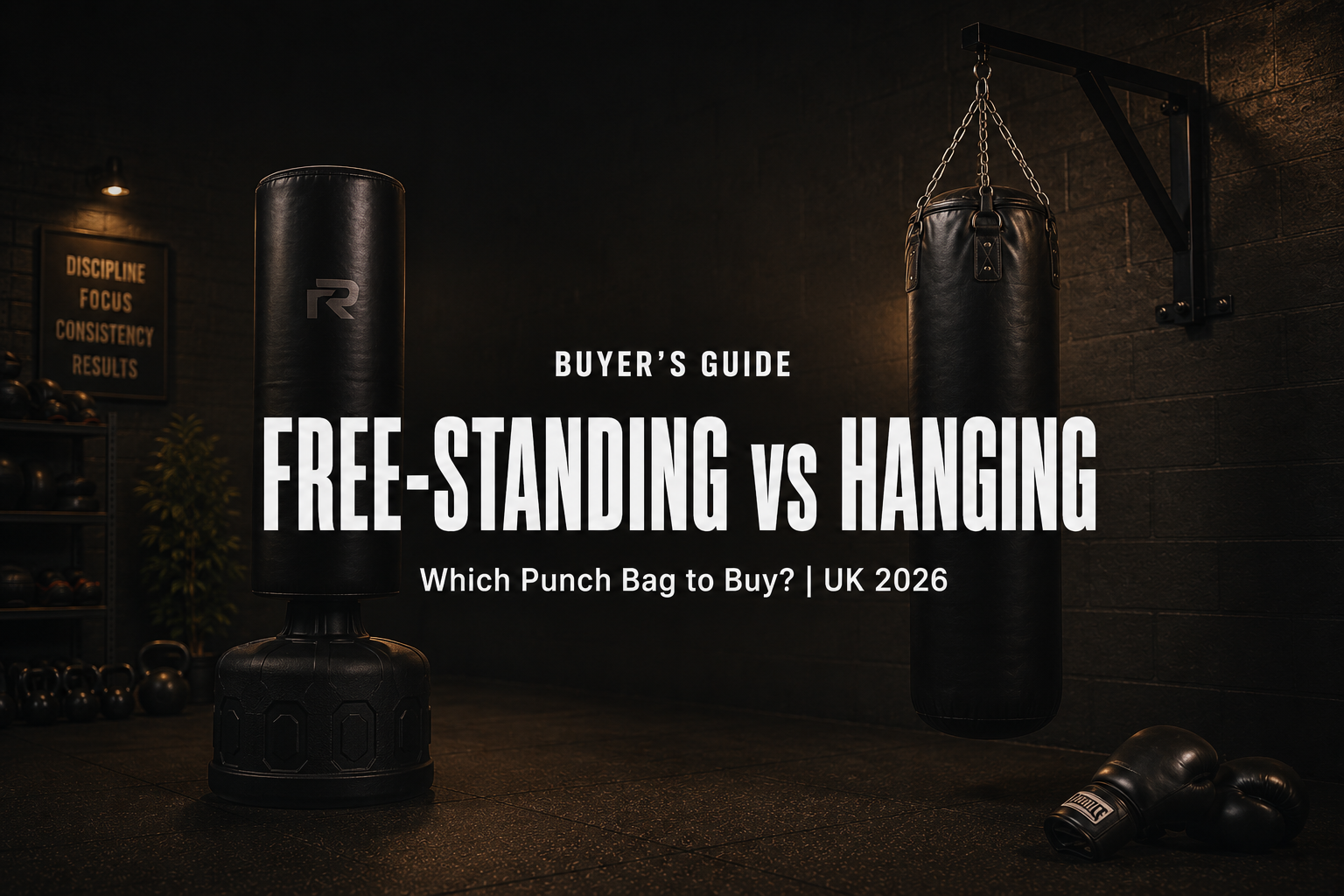
A hanging bag suspends from a wall bracket or ceiling mount on chains. It's the traditional setup — the bag every boxing gym uses. It swings and rebounds naturally, takes the heaviest punching, and feels like the real thing. But it needs a structural fixing point to hang from.
A free-standing bag sits on a weighted base on the floor. No mounting, no drilling, no structural wall needed — you fill the base, stand it up and train. It's the convenient, move-anywhere option, though a top-tier one is built heavy enough to take real power too.
One needs a solid wall. The other needs only a floor. That's the decision in a sentence — but the detail matters.
Hanging bags — the traditional choice
A hanging bag is what most serious boxers picture. Mounted properly, it gives the most authentic feel:
The most authentic movement. It swings and rebounds like a gym bag, so footwork, timing and combinations all translate.
Takes the heaviest punching. A well-mounted heavy bag absorbs full-power shots without going anywhere.
A range of sizes and weights. From lighter bags to serious heavy bags, you can match the bag exactly to your training.
The Ricky Hatton Professional Heavy Duty Punch Bag (from around £282) is a professional-grade hanging bag with consistent rebound and balanced resistance, built for serious home and commercial training.
The catch: it needs a proper mount. You'll need a structural wall or beam and a rated bracket like the JORDAN Wall Brackets for Boxing Bags (from around £92), plus a heavy-duty chain set (around £48). If you've got the wall, it's the best feel there is.
Free-standing bags — the convenient choice
A free-standing bag removes the biggest barrier — mounting:
No fixing required. No drilling, no structural wall, no ceiling mount. Fill the base and train.
Move it anywhere. Roll or shift it out of the way, train in different rooms, take it with you.
Ideal for rented homes and tricky walls. If you can't or won't drill into the wall, this is the answer.
The JORDAN Freestanding Punch Bag (around £899) is a heavy-duty self-supporting bag engineered for durability and performance — a premium free-standing option built to take real training, not a wobbly budget stand.
The catch: even a heavy base moves under big shots more than a mounted bag, and the feel is slightly different from a true hanging bag. For most home training it's brilliant; for full-power heavy-bag work, a mounted bag still edges it.
Side by side
The quick comparison:
Mounting: Hanging — needs a structural wall or ceiling. Free-standing — none, sits on the floor. Feel: Hanging — most authentic swing and rebound. Free-standing — good, slightly different. Heaviest punching: Hanging — takes full power best. Free-standing — strong, but the base can shift. Portability: Hanging — fixed in place. Free-standing — move it anywhere. Best for: Hanging — solid walls, serious power work. Free-standing — rented homes, flexible spaces, no drilling.
So which should you buy?
Here's the honest call:
Buy a hanging bag if you've got a structural wall or beam to mount to, want the most authentic feel, and plan to do serious heavy-bag power work. With the right bracket and chains, it's the closest thing to a real gym bag.
Buy a free-standing bag if you rent, can't or won't drill into walls, want to move the bag around, or simply want the simplest setup with no mounting. A quality one takes proper training without any of the fixing hassle.
Quick rule of thumb: if you can mount it, hang it — it's the better feel. If you can't, a premium free-standing bag is a brilliant no-compromise alternative. Either way, buy quality: a heavy-duty bag lasts for years.
Still choosing your bag overall? Our best punch bag guide and heavy punch bag guide go deeper on types and weights.
Setting either up
Rubber flooring underneath. Both need a protected, stable, grippy floor — see our best gym flooring guide. For a hanging bag, fix into structural wall or beam only, with a rated bracket and chains — full detail in our boxing corner setup checklist. For a free-standing bag, fill the base fully and place it on flat, level flooring with clearance to move around it. Glove and wrap up every session, whichever you choose.
Frequently asked questions
Is a free-standing or hanging punch bag better? Neither is universally better — it depends on your space. A hanging bag gives the most authentic feel and takes the heaviest punching, but needs a structural wall or ceiling to mount. A free-standing bag needs no fixing and moves anywhere, ideal for rented homes or tricky walls. Choose hanging if you can mount it, free-standing if you can't.
Do free-standing punch bags move when you hit them? A quality free-standing bag with a properly filled, heavy base stays largely planted for most training, but it will shift more than a mounted bag under full-power shots. For serious heavy-bag power work a hanging bag is steadier; for general boxing training, a premium free-standing bag holds up well.
Can I use a hanging bag if I rent? Only if you can fix a rated bracket into a structural wall or beam — which many rented homes don't allow. If drilling isn't an option, a free-standing bag is the better choice: it needs no mounting at all and can be moved or removed without trace.
What do I need to hang a punch bag? A structural wall or beam, a wall or ceiling bracket rated for the bag's weight, and a heavy-duty chain set to suspend it. Never mount a heavy bag to plasterboard alone. Our boxing corner setup checklist covers the full process.
Which punch bag is best for a home gym? The best one matches your space. If you have a solid wall, a hanging heavy bag gives the most authentic training. If you don't, or you want flexibility, a quality free-standing bag delivers serious training with zero mounting. Buy a heavy-duty bag either way so it lasts.
The bottom line
Free-standing or hanging comes down to your space: a hanging bag gives the most authentic feel and takes the hardest punching but needs a solid wall to mount; a free-standing bag needs no fixing and moves anywhere, perfect for rented homes and flexible setups. Decide whether you can mount, and the choice makes itself. Buy a quality, heavy-duty bag and it's a piece you'll train on for years.
Browse the full boxing range to compare bags, or plan the whole station with our boxing corner setup checklist and complete boxing equipment guide. Not sure which suits your home? Get in touch — we'll help you choose right first time.
Pro Gym Essentials — premium home and commercial gym equipment, delivered across the UK.
- Opens in a new window.