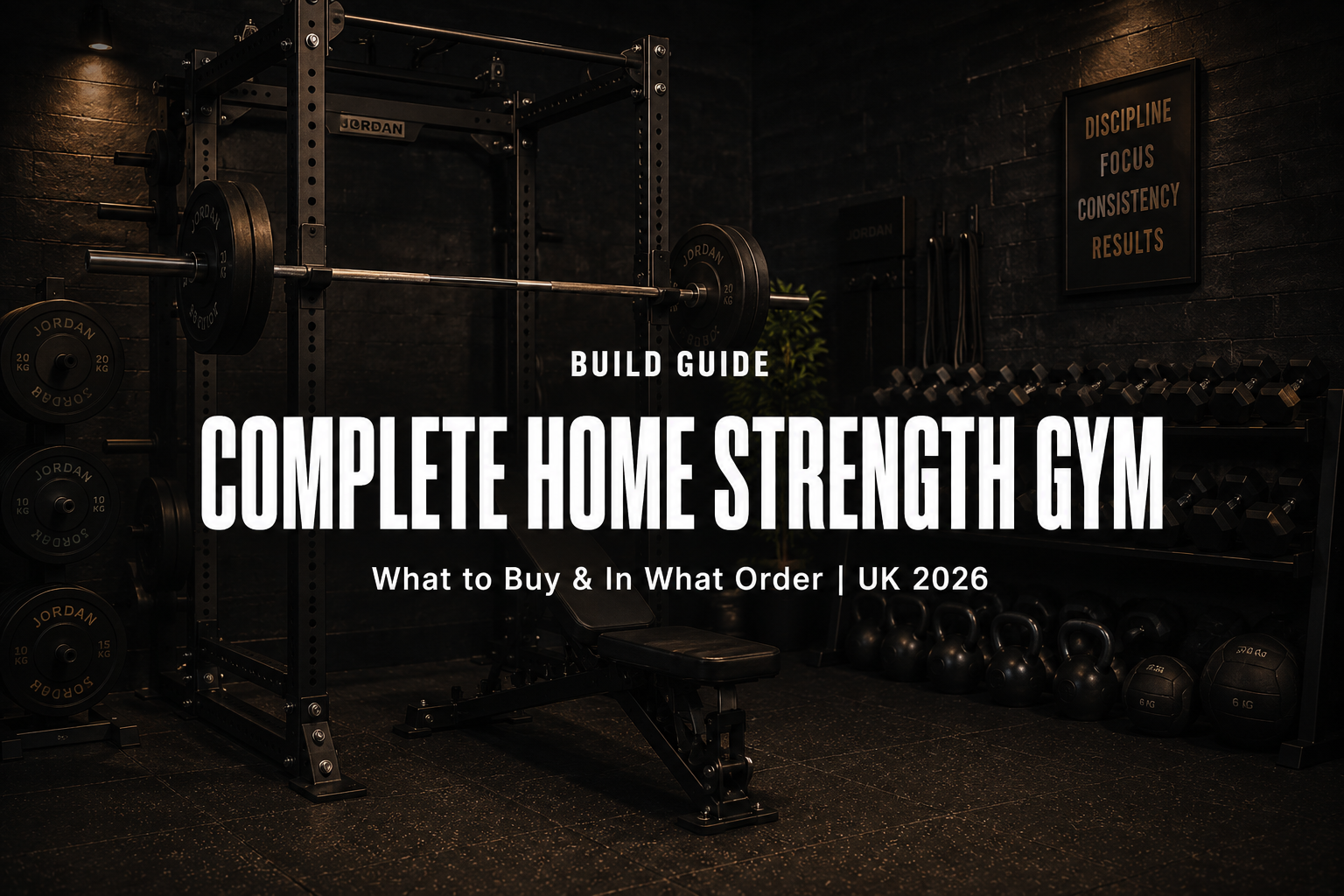
How to Build a Complete Home Strength Gym (2026)

A complete home strength gym isn't a single purchase — it's a handful of pieces that work together. Get the order and the quality right and you build a gym that does everything a commercial floor does, in your garage, for years. Get it wrong and you end up with mismatched kit, a bar that bends, and a setup you outgrow in a season.
This guide lays out exactly what to buy, in what order, and roughly what it costs in the UK — the buy-it-once way. We'll build from the foundation up: floor, rack, bar, plates, bench, then the additions that round it out. No filler, just the build.
Build in the right order
Spend in this order and every piece lands on a proper foundation:
1. Flooring — goes down first, before anything else. 2. Rack — the centre of the gym; everything works around it. 3. Barbell — the tool you'll use most. 4. Plates — load for the bar. 5. Bench — unlocks pressing and accessory work. 6. Dumbbells, then cables — the additions that complete it.
Do it in this sequence and you're never shifting a loaded room to fix a skipped step.
1. Flooring — lay it first
Flooring is the most overlooked piece and the one to buy first. It protects your subfloor from dropped weight, cushions your joints, kills noise and stops kit sliding. Heavy equipment should go straight down onto a protected surface — retrofitting later means emptying the whole room.
Lay rubber across the training area, with extra thickness under the rack and any dropping zone. For the full breakdown of rolls versus tiles and how thick to go, see our best gym flooring guide.
2. The rack — the heart of it
The rack is the single most important purchase. It's what makes squatting, pressing and pulling heavy safe when you train alone — the safety bars catch a failed rep so you can push hard without a spotter.
For most home gyms, a full power rack is the right call, and a quality one costs less than people expect. The JORDAN HELIX Fixed Power Rack (around £900) delivers commercial build and full safety at a price that anchors a serious setup. If you're weighing a cage against a half rack or squat stand, our power rack vs squat rack guide settles it, and our best power rack guide compares specific models.
3. The barbell — don't cheap out here
A great rack is wasted on a bending, badly knurled bar. The bar is the tool your hands are on every session, so it's worth getting right.
A quality Olympic bar like the JORDAN Steel Series Bar (from around £162) gives the right whip, grippy knurling and a load rating built for heavy work — and it'll outlast the gym. For the full rundown on load ratings, knurl and whip, see our best barbells guide.
4. The plates — load the bar properly
Plates are a buy-it-once purchase if you choose well. For most home gyms, droppable rubber bumper plates are the answer — they take a drop, protect your bar and floor, and suit deadlifts and solo training.
The JORDAN HG Black Rubber Bumper Set (around £672 for 150kg) is a complete starting set that covers most training out of the box, with room to add as you get stronger. Our weight plates guide covers bumper vs iron vs urethane and how much to buy.
5. The bench — unlock pressing
A bench turns a squat-and-deadlift setup into a full strength gym: flat and incline pressing, supported dumbbell work, rows and accessories. An adjustable bench earns its place by covering far more than a flat one.
The JORDAN HELIX Adjustable Weight Bench (around £356) is a commercial-grade adjustable bench that handles heavy pressing and angles for incline work — a lot of capability for the spend.
6. The additions — dumbbells and cables
With the barbell core in place, two additions complete the gym.
Dumbbells cover everything the bar can't — single-arm work, pressing variations, accessory and rehab movements. A graded set like the JORDAN Rubber Dumbbell Set (from around £521.40) is the buy-it-once choice; our dumbbells guide covers finishes and ranges.
A cable machine is the best single addition once the basics are in — rows, pulldowns, flyes and dozens of accessory movements in one footprint. See our cable machine guide for the formats that fit a home gym.
What it actually costs
Here's an honest UK picture, built in tiers rather than a single magic number:
The barbell core — squat, press, deadlift. Rack (£900) + bar (from £162) + bumper set (£672) + adjustable bench (£356) lands around £2,100, plus flooring. That's a complete, commercial-grade setup that does the big lifts safely and lasts for years.
The full free-weight gym. Add a graded dumbbell set (from ~£521) and you're around £2,600–2,700 — a setup that covers virtually all free-weight training.
The complete strength station. Add a cable machine and storage and you've built something that rivals a commercial floor.
The point isn't the lowest possible price — it's that buying quality once is cheaper than replacing cheap kit twice. Every piece here is built to be the last one you buy.
Setting it up right
Lay flooring first, then build on top of it. Bolt or anchor the rack if you train heavy, and set the safeties every session. Plan your space — measure floor and ceiling height before buying the rack and bar. Buy the core first, add over time — the rack, bar, plates and bench get you training; dumbbells and cables can follow.
For how every piece fits together in detail, see our complete strength equipment guide.
Frequently asked questions
What do I need for a complete home strength gym? The core is flooring, a power rack, an Olympic barbell, a set of plates and an adjustable bench — that covers squat, press, deadlift and pressing work. Add a graded dumbbell set and a cable machine to complete it. Buy in that order so each piece lands on a proper foundation.
How much does a home strength gym cost in the UK? A complete, commercial-grade barbell core — rack, bar, bumper plates and adjustable bench — lands around £2,100 plus flooring. Adding dumbbells brings it to roughly £2,600–2,700, and a cable machine builds it into a full station. Buying quality once works out cheaper than replacing budget kit.
What should I buy first for a home gym? Flooring, then the rack. Flooring protects your subfloor and joints and must go down before heavy kit; the rack is the centre everything else works around. After that, add the barbell, plates and bench in order.
Do I need a power rack or will a squat stand do? A full power rack is the safest, most capable choice and a quality one is more affordable than most expect — it's the right pick for most home gyms. A squat stand suits the tightest spaces or hardest budgets; choose one with safety arms. Our power rack vs squat rack guide breaks it down.
Can I build a home gym over time? Yes — and it's the sensible way. Lay flooring and buy the rack, bar, plates and bench to start training, then add dumbbells, a cable machine and storage as budget allows. Buying quality pieces means nothing needs replacing as you expand.
The bottom line
A complete home strength gym is a sequence, not a single buy: floor first, then rack, bar, plates and bench for the core, then dumbbells and cables to finish it. Spend in that order, buy quality once, and you build a gym that does everything — and lasts for years instead of seasons.
Browse the full strength equipment range to plan your build, or start with the complete strength equipment guide. Want help speccing a complete setup for your space and budget? Get in touch — we'll build you a kit list that's right first time.
Pro Gym Essentials — premium home and commercial gym equipment, delivered across the UK.
- Opens in a new window.