
Punch Bag Stand vs Wall Bracket UK (2026): Which Should You Buy?

A hanging punch bag is only as good as whatever holds it up. Choosing between a punch bag stand and a wall bracket comes down to one question: do you have a structural wall you are allowed to drill into?
The short answer: if you have a solid brick or stone wall that can take the bag's weight and the force of it swinging, a wall bracket is the cheaper, more compact way to hang a bag, from £92. If you rent, have only plasterboard, or want several people training at once, a freestanding stand needs no fixings at all. The JORDAN multi-station frame we sell costs £1,194, and each of its hanging points is rated to 40kg, so pair it with bags of 40kg or less.
Key takeaways
- A wall bracket is the lowest-cost way to hang a heavy bag, but it must be fixed into a structural wall, never plasterboard alone.
- A punch bag stand (freestanding frame) needs no drilling, which suits rented homes, leased studios and listed buildings.
- The JORDAN boxing frame carries three bags and a speedball at once, with each hanging point rated up to 40kg, so a 50kg bag belongs on a wall bracket instead.
- Each JORDAN wall bracket has its own maximum bag weight, from 35kg on the 2ft Fixed to 150kg on the 1.25m Elite.
- England Boxing's club standard spaces striking stations at least 1.5 metres apart, a useful benchmark for any multi-bag setup.
What is the difference between a punch bag stand and a punch bag bracket?
Both hold a hanging bag. What changes is where the load goes.
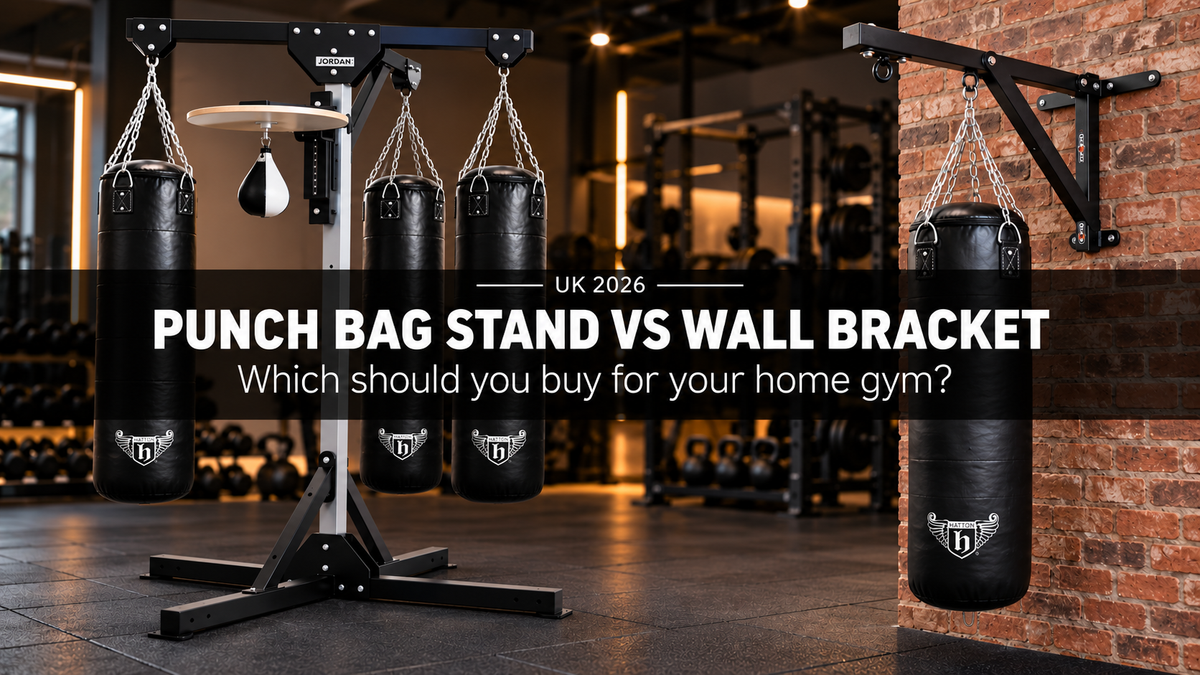
A punch bag bracket is a steel arm bolted to a wall. The bag hangs from the end of the arm on its chain, and every punch is transferred into the wall through the fixings. It takes almost no floor space but needs a structural wall.
A punch bag stand is a freestanding steel frame that sits on the floor and carries the bag from its own arm or arms. The frame absorbs the load, so nothing is drilled into the building. The trade-off is floor space and cost.
A free-standing punch bag, with a weighted base and no chain, is a different product. If you are still choosing the bag itself, our free-standing vs hanging punch bag guide covers that decision first.
When is a wall bracket the right choice?
When you own the property and have a solid brick or stone wall in the right place. It is the most compact, lowest-cost way to hang a heavy bag.
The JORDAN Wall Brackets for Boxing Bags come in four versions, all heavy-gauge steel designed for the extra force of a swinging bag rather than its static weight alone:
- 2ft Fixed Punch Bag Bracket (£92, up to 35kg): a compact, permanent arm for tight garages where you work the bag straight on.
- 3ft Folding Bracket (£120, up to 50kg): folds flat against the wall after training, so the room keeps its other uses.
- 1.25m Elite Punch Bag Wall Bracket, inc D-shackle (£238, up to 150kg): with a 500kg stainless steel swivel and enough reach for full 360-degree footwork.
- Retractable Punch Bag Bracket (£358, up to 40kg): retracts so the bag is out of the way between sessions.
The brackets are made for solid brick or stone walls, and the wall and fixings must be able to take the bag's weight and the force of it swinging. If you're not sure your wall is suitable, have it checked by a builder or structural engineer before drilling.
 JORDAN Wall Brackets for Boxing Bags£92 – £358View product →
 JORDAN Punch Bag ChainsFrom £48View product →
When is a freestanding stand the better buy?
When drilling is not an option, or when more than one person trains at a time. A stand removes the structural question entirely, because the frame carries the load.
The JORDAN 3 bag arms and speedball platform boxing frame (£1,194, punch bags not included) gives four training stations in one footprint: three bag arms and a built-in speedball platform. It is designed for leased studios, residential gyms and listed buildings.
For a PT studio, a family gym or a small class, one frame does the job of three brackets and a speedball platform.
The figure to plan around is the rating: each hanging point is rated up to 40kg.
 JORDAN 3 bag arms and speedball platform boxing frameFrom £1,194View product →
 All Boxing EquipmentFrom £48View range →
Which bag weight can each mount take?
Match the bag to the mount's rating, not the other way round. This is where most buyers go wrong, because the heaviest bag is not always the right bag for a frame.
The Ricky Hatton Professional Boxing Heavy Duty Punch Bag comes in two sizes. The 100 × 40cm bag weighs approximately 35kg (£174 in PU, £282 in leather). The 130 × 40cm bag weighs approximately 50kg (£218 in PU, £312 in leather). Both are supplied with a six-hook chain.
- On the JORDAN frame: the 100 × 40cm bag, at around 35kg, sits within the 40kg rating per hanging point. The 130 × 40cm bag, at around 50kg, does not.
- On a wall bracket: check the bracket's maximum against the bag. The 1.25m Elite's 150kg rating comfortably covers either size; the other three brackets are rated from 35kg to 50kg.
Ricky Hatton Professional Boxing Heavy Duty Punch BagFrom £174View product → All Punch BagsFrom £48View range →
Not sure which weight you need? Our heavy punch bag guide explains how to choose by size and training style.
Punch bag stand vs wall bracket: how do they compare?
Prices and maximum bag weights are from our live product pages.
| Mount | Price | Fixing needed | Max bag weight | Best for |
|---|---|---|---|---|
| 2ft Fixed bracket | £92 | Solid brick or stone wall | 35kg | Tight garages, straight-on bag work |
| 3ft Folding bracket | £120 | Solid brick or stone wall | 50kg | Multi-use rooms that need the space back |
| 1.25m Elite bracket | £238 | Solid brick or stone wall | 150kg; 500kg swivel | Heavy bags and full footwork around the bag |
| Retractable bracket | £358 | Solid brick or stone wall | 40kg | Rooms where the bag must disappear |
| JORDAN boxing frame (stand) | £1,194 | None | 40kg per hanging point | Renters, leased studios, listed buildings, groups |
Can you hang a punch bag from the ceiling instead?
Only from a structural joist or beam, and only with fixings rated for a moving load. It is the traditional gym option, but the least forgiving at home.
Plasterboard will not hold a heavy bag, and a swinging bag loads a fixing far harder than its static weight suggests. If you can't confirm where your joists run and what they will carry, ask a structural engineer before drilling.
Our mounting range covers wall brackets and freestanding frames rather than ceiling fixings. For most UK homes, a bracket on a solid wall or a freestanding frame is simpler to get right.
On a commercial floor, the HSE is clear that where the safety of work equipment depends on the installation conditions, it should be inspected after installation, and at intervals set by risk assessment. That applies to brackets and frames just as much as to cardio machines.
How much space does each option need?
A bracket needs wall and swing room. A stand needs its own footprint plus room around every station.
For a single bracket, allow clear space on every side of the bag for footwork, and check it cannot swing into a door, window or radiator.
For multiple bags, use the club benchmark. England Boxing's New Club Setup Guide requires punch bags and striking equipment to be "at least 1.5 metres apart", with "sufficient space around equipment for it to be used safely". It also requires bag chains and fastenings to be secure, with no broken or worn links.
The JORDAN boxing frame has a 1825 × 1650mm footprint and stands 2570mm tall, so mark it out on the floor and check your ceiling height before ordering. Whichever mount you choose, lay rubber flooring first; our best gym flooring guide covers thickness and coverage.
What does a complete setup cost?
A single-bag wall setup starts at £294; a three-bag frame setup starts at £1,716.
| Setup | What it includes | Total |
|---|---|---|
| Folding wall setup | 3ft Folding bracket + Hatton 100 × 40cm PU bag | £294 |
| Full-footwork wall setup | 1.25m Elite bracket + Hatton 130 × 40cm leather bag | £550 |
| Three-bag frame setup | JORDAN boxing frame + three Hatton 100 × 40cm PU bags | £1,716 |
The workout is the same whichever mount you choose. The 2024 Adult Compendium of Physical Activities rates boxing on a punching bag at 5.8 METs, rising to 10.8 METs at a fast 180 punches per minute.
Fitting out a gym or studio rather than a home corner? The BOX12 Boxing Pod (£7,440) is a freestanding, self-contained station that runs structured 12-round sessions with on-screen Hatton Boxing Academy coaching.
Which should you buy?
Buy a wall bracket if you own the property, have a solid brick or stone wall that can take the bag where it should hang, and want the lowest-cost, most compact setup. Choose the 3ft Folding for multi-use rooms and the 1.25m Elite for heavy bags and full footwork.
Buy a freestanding stand if you rent, have only plasterboard, train in a listed or leased building, or want three people hitting bags at once. Hang bags of 40kg or less, such as the Hatton 100 × 40cm.
For the full station checklist, from flooring to gloves, see our boxing corner setup guide. To compare every bag we sell, read our punch bag buyer's guide.
How are brackets and frames delivered?
Delivery is £20 on orders below £250 and free on orders of £250 or more, so the JORDAN boxing frame ships free. Once stock is confirmed, orders are normally dispatched within 5 working days, with tracking emailed within 24 hours of dispatch. If an item is out of stock, we'll contact you before you're charged.
Brackets and chains are delivered by courier. If you want the boxing frame assembled or installed on site, ask us to confirm this is available for your order before you buy.
Not sure which mount suits your room?
Tell us your wall type, ceiling height and the bag you want to hang, and we'll confirm the right bracket or frame before you order.
Shop boxing equipment →Call 0333 880 3211on orders of £250 or moreCommercial-grade kit
Jordan, Hatton, Concept2Finance available
business & commercialRated by UK buyers
read our reviews
Frequently asked questions
Is a punch bag stand as stable as a wall bracket? A well-built steel frame is stable for normal bag work, but only within its rating. The JORDAN boxing frame is rated up to 40kg per hanging point. For a 50kg bag, use a wall bracket rated for that weight, such as the 1.25m Elite (rated to 150kg), fitted to a suitable wall.
Can I put a punch bag bracket on a plasterboard wall? No. A punch bag bracket must be fixed into a solid brick or stone wall that can take the bag's weight and the repeated force of it swinging. If the only wall available is plasterboard on a stud frame, or you can't confirm what is behind it, have it checked by a builder or structural engineer, or choose a freestanding frame or a free-standing bag instead.
Can I hang a 50kg punch bag on the JORDAN boxing frame? No. Each hanging point on the JORDAN 3 bag arms and speedball platform boxing frame is rated up to 40kg, and the Hatton 130 × 40cm bag weighs approximately 50kg. The Hatton 100 × 40cm bag, at approximately 35kg, sits within the rating. If you want a 50kg bag, mount it on a suitable wall with a bracket rated for that weight.
Do I need to buy a chain with my bracket or stand? Not with the Ricky Hatton Professional Heavy Duty Punch Bag, which is supplied with a six-hook chain. If your bag came with straps or a worn chain, the JORDAN Punch Bag Chains (£48) use six steel strands to spread the load evenly and stop the bag tilting off-axis.
Is a freestanding stand good for renters? Yes, it is the main reason to choose one. A freestanding frame needs no drilling, so it leaves nothing behind when you move. The trade-off is floor space and price: the JORDAN boxing frame costs £1,194, while JORDAN wall brackets start at £92.
Which wall bracket gives the most room to move around the bag? The 1.25m Elite Punch Bag Wall Bracket (£238). Its longer arm holds the bag far enough from the wall for full 360-degree footwork, and it comes with a D-shackle and a 500kg stainless steel swivel.
Get more guides like this
Join the Pro Gym Essentials list for new buying guides, training sessions and offers we don't publish on the site.
No spam. Unsubscribe any time.
Pro Gym Essentials — premium home and commercial gym equipment, delivered across UK mainland. Prices and product details taken from our live product pages, 27 October 2026. Sources: England Boxing, New Club Setup Guide (2025); HSE, Inspection of work equipment; 2024 Adult Compendium of Physical Activities.