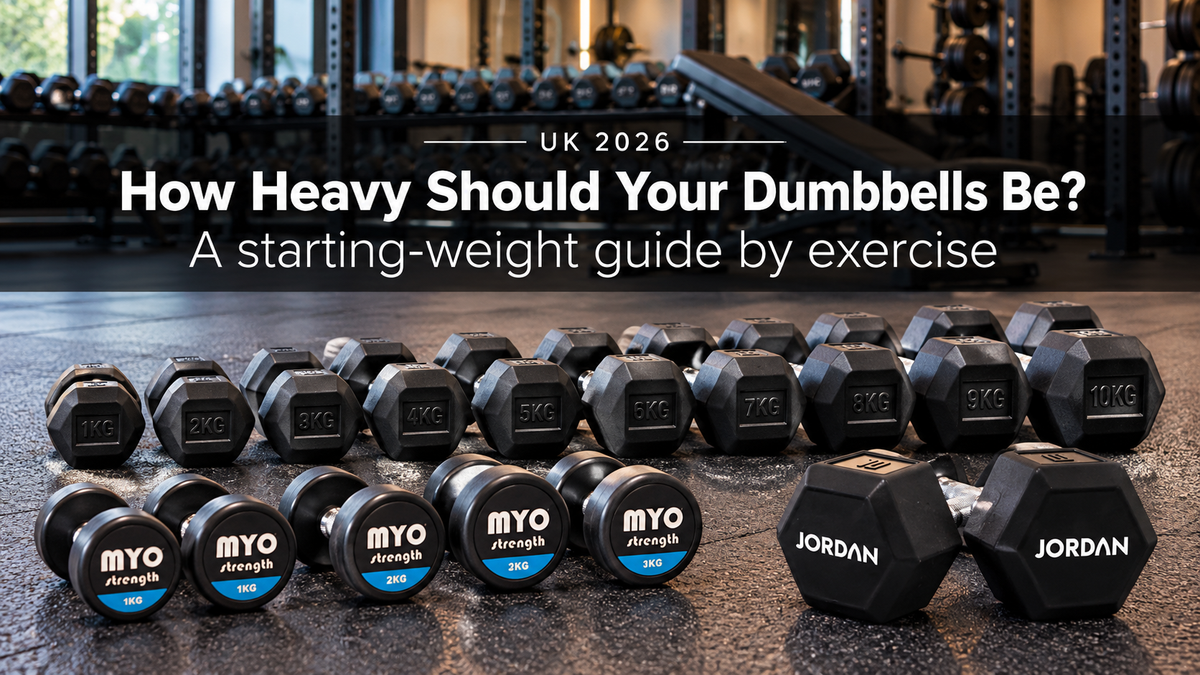

How Heavy Should Your Dumbbells Be? A UK Starting-Weight Guide (2026)

Your dumbbells are the right weight when you can complete your target reps with good form and about two reps still in reserve. If you could do five more, it is too light; if your form breaks before the last rep, it is too heavy.
The short answer: there is no single "right" dumbbell, because a lateral raise and a row need very different loads. As a rough example, many beginners start somewhere between 2–5kg for shoulder raises and 8–15kg for rows and goblet squats, then move up once they can beat their target reps for two sessions running. That is why a home gym needs three or four pairs to start, not one.
Key takeaways
- Choose by effort, not by number. The right weight leaves about two reps in reserve at the end of each set, which on a 0–10 effort scale is roughly 7–8.
- Different exercises need different dumbbells. Small-muscle lifts such as lateral raises often use a third of the weight of a row, so one pair cannot cover a full workout.
- Training to failure is optional. The American College of Sports Medicine's 2026 position stand found that training to momentary failure did not consistently change results for the average healthy adult.
- Go up when you beat your reps twice. The ACSM recommends a 2–10% load increase once you can do one or two reps more than your target on two consecutive sessions.
- Small steps matter most at the light end. Going from 4kg to 5kg is a 25% jump; from 4kg to 6.5kg would be more than 60%, which is why 1kg increments up to 10kg are worth having.
How do you know if a dumbbell is the right weight?
Do a set of your target reps and ask how many more you could have done with clean form. Two left in the tank is the sweet spot for most sets; zero means too heavy, five or more means too light.
This "reps in reserve" method is how strength coaches rate effort. A 2016 study in the Journal of Strength and Conditioning Research by Michael Zourdos and colleagues set out the reps-in-reserve effort scale, where an effort of 10 means no reps left and 9 means one rep left.
NHS Lothian's patient guide to progressing strengthening exercises uses the same idea on a 0–10 scale, building from an effort of 5–6 up to 7–8. It also notes that exercising at an effort of 10 is not required to build strength and muscle size.
What weight dumbbells should a beginner start with?
Start light enough to learn the movement, then find your working weight within the first two or three sessions. The table below gives example starting ranges per dumbbell for healthy adults. They are illustrations, not prescriptions: treat them as a first guess and adjust using the two-reps-in-reserve test.
| Exercise (per dumbbell) | New to lifting | Some training experience | Muscle size |
|---|---|---|---|
| Lateral raise | 2–4kg | 5–10kg | Small |
| Biceps curl | 4–7kg | 8–15kg | Small |
| Seated shoulder press | 5–9kg | 12.5–22.5kg | Medium |
| Flat bench press | 6–10kg | 15–30kg | Large |
| One-arm row | 8–12kg | 17.5–30kg | Large |
| Romanian deadlift | 8–12kg | 17.5–30kg | Large |
| Goblet squat (one dumbbell) | 8–15kg | 20–30kg | Large |
These ranges are a starting point, not a test you pass or fail. Age, body size and training history move them a lot, and the NHS Lothian guide suggests that complete beginners may need only bodyweight or very light weights at first.
If a range feels too heavy, drop to the lower end and add reps instead. Your working weight is whatever lets you finish the set with good form and about two reps to spare.
Why can't one pair of dumbbells cover a whole workout?
Because the muscles doing the work are very different sizes. A row uses the large muscles of the back; a lateral raise uses the much smaller side of the shoulder, at a long lever, so the same person often raises a third of what they row.
The UK Chief Medical Officers' guidelines say adults should do activities to develop or maintain strength in the major muscle groups on at least two days a week. Covering legs, back, chest, shoulders and arms properly takes a light pair, a medium pair and a heavy pair at minimum.
A single middle-weight pair ends up too heavy for raises and too light for rows and squats. That is the most common reason a home dumbbell routine stalls.
How many reps should you do, and does it change the weight?
Yes. Lower reps need a heavier dumbbell and higher reps a lighter one, but most home training sits in a middle range where the same pair works well.
| Goal | What the ACSM recommends | What it means with dumbbells |
|---|---|---|
| Getting started | 8–12 reps at 60–70% of your one-rep max (2009 stand) | A weight you can lift about 10 times with two to spare |
| Strength | Heavier loads, about 80% of one-rep max, 2–3 sets (2026 stand) | Fewer reps, heavier pair; easiest on presses, rows and squats |
| Muscle size | About 10 sets per muscle group per week (2026 stand) | Total weekly sets matter more than the exact pair |
| Muscular endurance | Light to moderate loads, 40–60% of one-rep max, higher reps (2009 stand) | Lighter pair, 15 or more reps |
The American College of Sports Medicine's 2026 position stand drew on 137 systematic reviews covering more than 30,000 participants. It concluded that consistency matters more than a perfect plan, and that free weights versus machines did not consistently change results for the average healthy adult.
The earlier figures come from the ACSM's 2009 position stand, Progression Models in Resistance Training for Healthy Adults, which the 2026 stand updates.
When should you move up to a heavier dumbbell?
When you can do one or two reps more than your target on two sessions in a row. The ACSM's 2009 position stand recommends a 2–10% load increase at that point, smaller for small-muscle lifts and larger for big ones.
Dumbbells rarely allow a jump that small. Look at the percentages:
| Current dumbbell | Next pair in 1kg steps | Jump | Next pair in 2.5kg steps | Jump |
|---|---|---|---|---|
| 4kg | 5kg | 25% | 6.5kg | 63% |
| 7.5kg | 8.5kg | 13% | 10kg | 33% |
| 10kg | 11kg | 10% | 12.5kg | 25% |
| 15kg | 16kg | 7% | 17.5kg | 17% |
| 20kg | 21kg | 5% | 22.5kg | 13% |
| 25kg | 26kg | 4% | 27.5kg | 10% |
The weights in this table are illustrative increments to show the size of each step; they are not necessarily pairs we stock. Most dumbbell ranges move in 2.5kg steps above 10kg. At the light end a 2.5kg step is a huge jump, which is why 1kg increments up to 10kg are worth paying for if you train shoulders and arms seriously.
The practical fix is double progression. Pick a rep range such as 8–12, stay on the same pair until you hit 12 on every set for two sessions, then move up and drop back to 8. Change one thing at a time, reps or weight, which is also what the NHS Lothian guide advises.
 MYO Strength 1kg – 10kg Rubber Dumbbell Set (1kg Increments)£600View product →
 JORDAN HEX Dumbbells - Urethane£13 – £2,084View product →
Which dumbbell pairs should you buy first?
Three or four pairs that bracket your current working weights: one for small-muscle lifts, one or two for presses, and one for rows and squats. Add pairs in between as you get stronger.
The JORDAN HEX Dumbbells - Urethane are sold as individual pairs in 1kg steps from 1kg to 10kg, then in 2.5kg steps to 30kg, so you can buy exactly the pairs you need. On our live prices:
| Starter plan | Pairs | Price | Covers |
|---|---|---|---|
| Newer or lighter lifter | 3kg, 5kg, 7kg, 10kg | £323 | Raises and curls up to rows and goblet squats |
| Stronger or more experienced lifter | 10kg, 15kg, 20kg, 25kg | £782 | Curls and raises up to heavy rows, presses and squats |
Both plans clear our £250 free-delivery threshold. Buy the middle pair first if budget is tight: it is the one you will use for the most exercises.
For a wider range in one go, look at the sets. The JORDAN Hex Rubber Dumbbell Set covers 2.5–25kg in 10 pairs for £825, only £43 more than the four-pair stronger starter plan above, though in virgin rubber rather than urethane.
 JORDAN Hex Rubber Dumbbell Set£825 – £3,150View product →
 MYO Strength Rubber Dumbbell Sets (2.5kg Increments)£960 – £13,440View product →
Is a full dumbbell set better value than buying pairs?
Per kilo, often yes, but only if you will use the whole range. A full set includes pairs you may not need for years, so compare total cost as well as cost per kilo.
| Option | Range | Total weight | Price | Per kg |
|---|---|---|---|---|
| JORDAN Hex Rubber Dumbbell Set | 2.5–25kg, 10 pairs | 275kg | £825 | £3.00 |
| JORDAN Hex Rubber Dumbbell Set | 2.5–30kg, 12 pairs | 390kg | £1,170 | £3.00 |
| MYO Strength Rubber Dumbbell Sets (2.5kg Increments) | 2.5–25kg, 10 pairs | 275kg | £1,440 | £5.24 |
| JORDAN HEX Dumbbells - Urethane, set | 2.5–25kg, 10 pairs | 275kg | £1,477 | £5.37 |
| MYO Strength 1kg – 10kg Rubber Dumbbell Set | 1–10kg, 10 pairs | 110kg | £600 | £5.45 |
| JORDAN HEX Dumbbells - Urethane, set | 1–10kg, 10 pairs | 110kg | £708 | £6.44 |
The 1–10kg sets cost more per kilo because light dumbbells carry more handle and coating per kilo of iron. They earn their place where small steps matter: beginners, older adults, shoulder work and rehab-style programmes.
For the full comparison of finishes and ranges, see our guide to choosing a dumbbell set and our Jordan dumbbells guide.
What dumbbell weights does a couple or household need?
A range that runs from the lighter person's smallest lift to the stronger person's heaviest. In practice that usually means starting low at 2–3kg and running up to 20–25kg.
Very different starting strengths are where 1kg steps earn their keep. A lighter lifter progressing a shoulder press from 5kg to 6kg is making a normal jump; 5kg to 7.5kg is a 50% leap that often forces a step back.
If you train at the same time, check the overlap. Two people both rowing with the 15kg pair in the same session means buying it twice or alternating exercises.
How heavy should dumbbells go in a PT studio or commercial gym?
Size the range to your members, not your strongest lifter. A class or studio floor is usually well served by 2.5–20kg or 2.5–25kg; a PT studio by 2.5–30kg; a commercial free-weights area by 2.5–50kg.
The MYO Strength Rubber Dumbbell Sets run from 2.5–20kg (8 pairs, £960) to 2.5–80kg (32 pairs, £13,440) in 2.5kg steps. For light class work, the JORDAN Neoprene Studio Hex Dumbbells & Sets come as pairs from 0.5kg to 10kg, or as 42-pair sets with a rack.
Business finance through Vercas Financial is available on orders of £5,000 and above, for UK limited companies and partnerships of four or more partners. The MYO 2.5–50kg set (£5,520) and larger qualify on their own.
 JORDAN Neoprene Studio Hex Dumbbells & Sets£4 – £1,938View product →
 All dumbbellsPairs from £4View range →
Where should you keep the pairs you buy?
On a rack, in weight order, never loose on the floor. Dumbbells left on the floor are a trip hazard and slow you down when you need to change weight between sets.
Hex dumbbells sit best on flat trays, such as the JORDAN 12 Pair, 3 Tier Hex Dumbbell Rack with Trays (£552). For a small room, the MYO Strength 10 Pair Vertical Curved Dumbbell Rack (£330) stores pairs upright. Our gym storage guide compares the options.
 JORDAN 12 Pair, 3 Tier Hex Dumbbell Rack with Trays£552View product →
 All dumbbell storage£330 – £999View range →
What else makes dumbbell training work at home?
A bench, a clear floor and a plan that covers every major muscle group twice a week. Dumbbells are the most flexible tool in a home gym, but presses and rows need something to lie or kneel on.
- Bench: an adjustable bench opens up incline presses and supported rows. Our weight bench buying guide compares flat and adjustable options.
- Barbell and plates: once squats and deadlifts outgrow your heaviest dumbbell, a bar takes over. See how many weight plates you need.
- Kettlebells: swings and carries complement dumbbell work. Our kettlebell buying guide covers weights by exercise.
For the whole build in order, see our complete home strength gym guide.
How are dumbbells delivered?
Delivery is £20 on orders below £250 and free on orders of £250 or more. Every dumbbell set and rack named in this guide clears the threshold on its own; single light pairs do not, so order the pairs you need together.
Orders are dispatched within 5 working days, with tracking emailed within 24 hours of dispatch, and delivered across UK mainland by our delivery partners. We do not deliver to Northern Ireland.
Not sure which pairs to start with?
Tell us the exercises you do and roughly what you lift now, and we'll suggest the pairs or set that fit. Free UK delivery on orders of £250 or more.
See all dumbbells → Call 0333 880 3211What should you tell us before ordering dumbbells?
Three things: who will train, the heaviest dumbbell you use now for rows or squats, and the lightest you use for raises. Those two numbers set the range; the number of people sets how many pairs overlap.
For a studio or gym, add how many people train at once and what the sessions are. That decides whether you need a single run of pairs or duplicates of the popular weights.
on orders of £250 or more Commercial-grade kit
StairMaster, Concept2, Star Trac, Jordan Finance available
business & commercial Rated by UK buyers
read our reviews
Frequently asked questions
Is a 10kg dumbbell heavy for a beginner? It depends on the exercise. For a one-arm row, a goblet squat or a Romanian deadlift, 10kg is a normal starting weight for many adults. For a lateral raise or a biceps curl it is heavy, and many beginners start nearer 2–7kg. Use the two-reps-in-reserve test: if you finish your set with about two reps to spare and good form, the weight is right for that exercise.
Should I buy 5kg or 10kg dumbbells first? Neither on its own. A 5kg pair suits raises, curls and some presses, while a 10kg pair suits rows and squats, so buying only one leaves half your workout too light or too heavy. If you can only buy one pair now, choose the weight you would use for your most common exercises, then add a lighter and a heavier pair next.
What weights should an older adult or a returning lifter start with? Lighter than you expect, and with small steps. NHS Lothian's strengthening guide suggests starting with bodyweight or light weights and progressing gradually. The ACSM's 2009 position stand recommends 60–80% of one-rep max for 8–12 reps for older adults. A 1–10kg range in 1kg increments, such as the MYO Strength 1kg – 10kg set at £600, keeps every step manageable.
Is it better to lift light for more reps or heavy for fewer? Both work; the right choice depends on your goal. The ACSM's 2026 position stand recommends about 80% of one-rep max for 2–3 sets when strength is the goal, and around 10 sets per muscle group a week for muscle size. Most home lifters do well with 8–12 reps on most exercises.
How heavy should a home dumbbell range go? For most adults, a range to 25kg covers rows, presses and squats, and 30kg leaves room to grow. Above that, a barbell usually takes over for squats and deadlifts. The JORDAN Hex Rubber Dumbbell Set comes in 2.5–25kg (£825) and 2.5–30kg (£1,170) versions, both in 2.5kg steps.
Do single dumbbell pairs qualify for free delivery? Only if the order reaches £250. Delivery is free on orders of £250 or more and £20 below that. A single light pair will not reach the threshold, but three or four pairs ordered together usually will; our newer-lifter starter plan of 3, 5, 7 and 10kg comes to £323. We deliver to UK mainland only, not Northern Ireland.
Get more guides like this
Join the Pro Gym Essentials list for equipment buying guides, spec comparisons and offers we don't publish on the site.
No spam. Unsubscribe any time.
Pro Gym Essentials — premium home and commercial gym equipment, delivered across UK mainland. Prices taken from our live product pages, 21 October 2026; training guidance from the American College of Sports Medicine (2009 and 2026 position stands), the UK Chief Medical Officers' physical activity guidelines, NHS Lothian and Zourdos et al. (2016), checked 21 October 2026.