
How Many Weight Plates Do You Need? A UK Home Gym Guide (2026)

Most home lifters need 100–150kg of weight plates, bought in pairs, plus a pair each of 2.5kg and 1.25kg change plates. That covers squats, presses, rows and deadlifts with room to progress for a year or more.
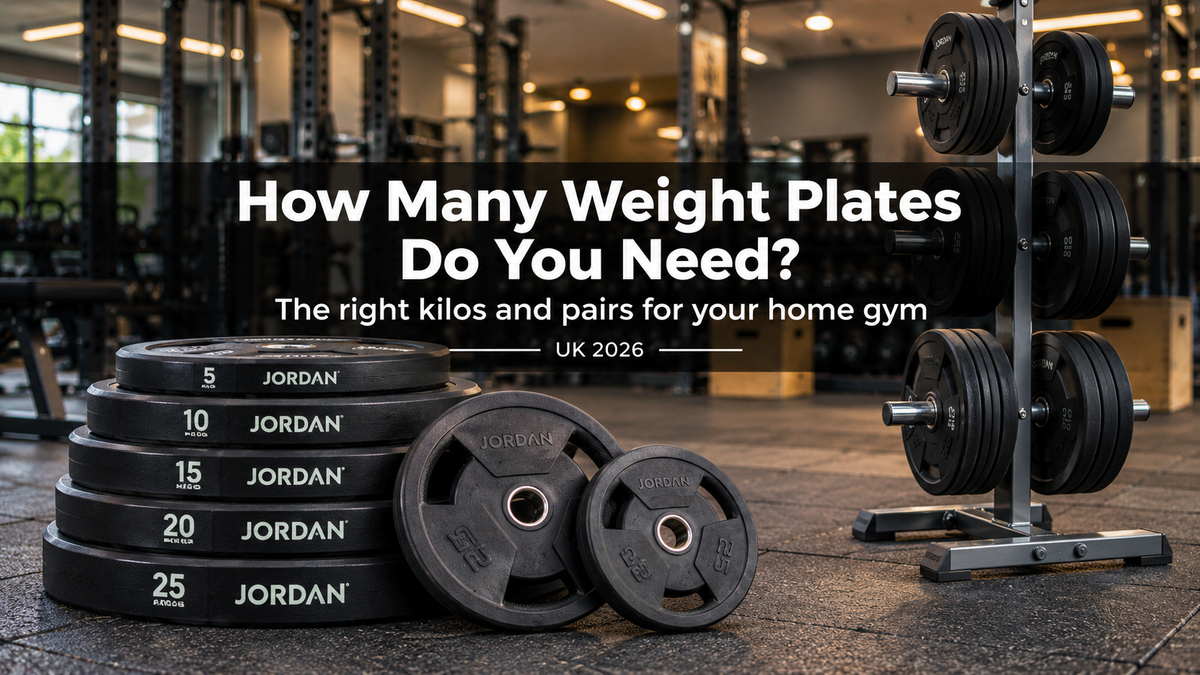
The short answer: work out the heaviest set you will lift in the next 12 months, take off the weight of your bar, and buy that much in pairs. For most people that is a 150kg set such as the JORDAN HG Black Rubber Bumper Plate Set (one pair each of 5, 10, 15, 20 and 25kg, £672). Add small plates so you can go up in 2.5kg steps rather than 10kg jumps.
Key takeaways
- Your heaviest lift sets the total. For most people that is the deadlift, so a 150kg plate collection on a 20kg bar (170kg loaded) lasts most home lifters for years.
- Your lightest lift sets the small plates. A pair of 1.25kg plates gives a 2.5kg jump, which is what keeps an overhead press progressing.
- One pair each of 1.25, 2.5, 5, 10, 15, 20 and 25kg (157.5kg) loads any weight from 20kg to 177.5kg in 2.5kg steps on a 20kg bar.
- The ACSM recommends adding 2–10% load once you can beat your target reps for two sessions running; small plates are what make that possible.
- Sets are cheaper per kilo than singles. On our live prices, the 150kg Black Rubber Bumper Plate Set costs £499 (£3.33/kg) against £528 for the same total weight bought plate by plate.
How many kilos of weight plates do you need?
Enough to load your heaviest working set for the next year, not your one-off best lift. For most home lifters that is 100–150kg of plates; strong lifters who deadlift well over 150kg need 200kg or more.
Working sets are lighter than maxes. The American College of Sports Medicine's 2026 position stand, built on 137 systematic reviews representing more than 30,000 participants, recommends heavier loads of around 80% of your one-rep max for 2–3 sets when the goal is strength. A lifter with a 175kg deadlift therefore trains at about 140kg, which is 120kg of plates on a 20kg bar.
That is why 150kg suits so many people. It covers that working set with headroom, and it is the size most bumper sets are sold in.
 JORDAN HG Black Rubber Bumper Plate Set - Coloured Fleck (150kg)£672View product →
 150kg Coloured Rubber Bumper Plate Set£672View product →
How do you work out your own number?
Use one sum: heaviest working set − bar weight = plates you need on the bar. Then add 20–40kg of headroom for the progress you expect over the next year.
Do it for your heaviest lift, which for most people is the deadlift. A standard men's Olympic bar weighs 20kg and a women's bar 15kg, according to the International Weightlifting Federation's equipment rules, but training bars vary, so check the listed weight of yours.
| Lift (20kg bar) | Example working set | Plates on the bar | Smallest useful jump |
|---|---|---|---|
| Overhead press | 40kg | 20kg | 2.5kg (2 × 1.25kg) |
| Bench press | 70kg | 50kg | 2.5kg |
| Back squat | 100kg | 80kg | 2.5–5kg |
| Deadlift | 140kg | 120kg | 5kg |
In this example the deadlift sets the total (120kg, so a 150kg collection) and the overhead press sets the small plates (a pair of 1.25kg). Every home gym plate order comes down to those two numbers.
Which plate pairs should you buy?
One pair of each weight from 1.25kg to 25kg. Plates always go on in pairs, one on each sleeve, so think in pairs rather than single plates.
| Plate | Quantity | Total | What it does |
|---|---|---|---|
| 25kg | 1 pair | 50kg | Bulk weight for squats and deadlifts |
| 20kg | 1 pair | 40kg | Bulk weight; with the 25s, 110kg loaded |
| 15kg | 1 pair | 30kg | Fills the gap between the big plates |
| 10kg | 1 pair | 20kg | Mid-range jumps and lighter lifts |
| 5kg | 1 pair | 10kg | 10kg jumps on the bar |
| 2.5kg | 1 pair | 5kg | 5kg jumps on the bar |
| 1.25kg | 1 pair | 2.5kg | 2.5kg jumps for presses |
| Total | 7 pairs | 157.5kg | 20–177.5kg loaded, every 2.5kg |
That spread loads every weight from an empty 20kg bar to 177.5kg in 2.5kg steps without a second pair of anything. A second pair of 20kg or 25kg plates is the first upgrade once your working deadlift passes about 175kg.
Bumper plates start at 5kg, so the 2.5kg and 1.25kg pairs come from the tri-grip range. The JORDAN Rubber Tri-Grip Olympic Weight Plates sell individually from £5 for 1.25kg and £11 for 2.5kg. They have a cast-iron core, so use them for controlled lifts and keep them off a bar you intend to drop.
 JORDAN Rubber Tri-Grip Olympic Weight Plates£5 – £4,289View product →
 JORDAN Urethane Tri-Grip Olympic Plates£7 – £4,980View product →
Why do small plates matter so much?
Because the jump you can make decides whether you keep progressing. The ACSM's position stand on progression models recommends a 2–10% increase in load once you can perform the current workload for one or two reps beyond your target on two consecutive sessions.
On a 40kg overhead press, a 5kg jump is 12.5%, beyond that range. A 2.5kg jump from a pair of 1.25kg plates is 6.25%, inside it. On a 140kg deadlift even 5kg is only 3.6%, so big lifts rarely need the smallest plates.
Small plates cost little. A pair of 1.25kg and a pair of 2.5kg rubber tri-grip plates is £32 on our live prices.
Is a plate set or individual plates better value?
A set, almost always. On our live prices, a full set costs less per kilo than the same total weight bought plate by plate, and the price per kilo falls further on 200kg sets.
| Option | Total | Price | Per kg | Built to be dropped? |
|---|---|---|---|---|
| JORDAN Black Rubber Bumper Weight Plates, 150kg set | 150kg | £499 | £3.33 | Yes |
| JORDAN Black Rubber Bumper Weight Plates, 100kg set | 100kg | £344 | £3.44 | Yes |
| JORDAN Coloured Rubber Bumper Plates, 150kg set | 150kg | £667 | £4.45 | Yes |
| JORDAN HG Black Rubber Bumper Plate Set - Coloured Fleck | 150kg | £672 | £4.48 | Yes |
| JORDAN Deep Dish Olympic Weight Plate Set | 200kg | £840 | £4.20 | No |
| JORDAN Classic Rubber Olympic Plate Set | 200kg | £843.60 | £4.22 | No |
| JORDAN Rubber Tri-Grip Olympic Weight Plates, 200kg set | 200kg | £858 | £4.29 | No |
The arithmetic on singles: one black bumper of each weight from 5kg to 25kg, in pairs, comes to 150kg for £528, against £499 for the 150kg set. In coloured bumpers the same 150kg costs £686 as singles and £667 as a set.
Singles still have a job. They let you add a second pair of 20s or 25s later without paying for weight you already own.
 JORDAN Black Rubber Bumper Weight Plates£26 – £499View product →
 JORDAN Coloured Rubber Bumper Plates£26 – £667View product →
 JORDAN Deep Dish Olympic Weight Plate Set£840 – £4,200View product →
 JORDAN Classic Rubber Olympic Plate Set£843.60 – £4,218View product →
Does the plate type change how many you need?
It changes how much fits on the bar, not how much you need. Bumper plates are thicker than iron plates of the same weight, so a bar runs out of sleeve sooner when it is loaded with bumpers.
For most home loads that is not a limit. If you load the bar very heavily and never drop it, denser iron plates such as the Deep Dish set (4 × 2.5kg, 6 × 5kg, 4 × 10kg, 2 × 15kg, 2 × 20kg, 2 × 25kg) fit more weight on a sleeve.
Whether you need bumpers at all depends on whether the bar leaves your hands. Our guide to bumper vs iron weight plates covers that choice, and our Jordan weight plates guide explains every Jordan plate type we stock.
How many plates does a shared or commercial gym need?
A full spread per loaded station, not one set for the room. If three racks can be in use at once, each needs its own pairs from 1.25kg to 25kg, or members queue for plates rather than equipment.
The Jordan sets scale to 1000kg for this reason. On our live prices the 1000kg options run from £4,200 (Deep Dish) and £4,218 (Classic Rubber) to £4,980 (Urethane Tri-Grip), £5,016 (Classic Urethane) and £6,120 (Urethane Dual Grip). Urethane suits floors where members handle plates all day, because it resists scuffing and keeps its markings legible.
Business finance through Vercas Financial is available on orders of £5,000 and above, for UK limited companies and partnerships of four or more partners. The two most expensive 1000kg sets qualify on their own.
Where will you store 150kg of plates?
On a weight tree or rack horns, never on the floor. Loose plates are a trip hazard, mark the floor and make it slow to find the pair you need.
The JORDAN Olympic Weight Tree (£228, black or grey) keeps a full set upright beside the rack. If you own a Jordan HELIX rack, storage horns attach to the frame instead; our Jordan gym storage guide compares the options.


What else do you need alongside the plates?
A bar rated for the load, a rack and a floor that can take it. Plates, bar and rack work as one system.
- Bar: an Olympic bar with 50mm sleeves to fit Olympic plates. Our best barbells guide compares the range.
- Rack: safety arms that let you squat and bench heavy alone. See our best power rack guide.
- Floor: rubber flooring under any bar that gets dropped or set down hard. Our gym flooring guide covers thicknesses.
The NHS recommends strengthening activities that work all the major muscle groups on at least two days a week, and lifting weights is one of the activities it lists. For the whole build in order, see our complete home strength gym guide.
How are weight plates delivered?
Delivery is £20 on orders below £250 and free on orders of £250 or more, so every 150kg set ships free. Individual light plates on their own fall below the threshold; order the pairs you need together and the order usually clears it.
Orders are dispatched within 5 working days, with tracking emailed within 24 hours of dispatch, and delivered across UK mainland by our delivery partners. We do not deliver to Northern Ireland. Full sets are heavy, so check the route from the kerb to your gym before ordering.
Not sure how many plates to order?
Tell us your bar, your heaviest working sets and whether you drop the bar, and we'll put together the exact pairs. Free UK delivery on orders of £250 or more.
See all weight plates → Call 0333 880 3211What should you tell us before ordering plates?
Three things: the bar you own, the heaviest working set you expect to reach in the next year, and whether you drop the bar. Those decide the total weight, the smallest pair and the plate type.
If more than one person trains, tell us how many lift at the same time. That decides whether one set is enough or each station needs its own.
on orders of £250 or more Commercial-grade kit
StairMaster, Concept2, Star Trac, Jordan Finance available
business & commercial Rated by UK buyers
read our reviews
Frequently asked questions
Is 100kg of weight plates enough for a home gym? For a beginner, yes, for the first months. On a 20kg bar it loads 120kg, which covers most new lifters' squats and deadlifts. Most people outgrow it within a year on the deadlift, so if budget allows, 150kg is the better first purchase: our 150kg Black Rubber Bumper Plate Set costs £499 against £344 for the 100kg set.
Is 150kg of plates enough? For most home lifters, yes. With a 20kg bar it loads 170kg, which covers working sets at about 80% of a deadlift of around 210kg. Add a second pair of 20kg or 25kg plates when your working deadlift passes about 170kg, rather than buying a whole new set.
Do I need 1.25kg plates? If you overhead press or bench, yes. A pair of 1.25kg plates gives a 2.5kg jump, which keeps light lifts progressing. The ACSM recommends load increases of 2–10%, and on a 40kg press a 5kg jump is 12.5%. Our rubber tri-grip 1.25kg plates are £5 each.
Can I mix bumper plates and iron plates on the same bar? Yes, for controlled lifts. Put the bumpers on first and the smaller iron change plates outside them. Don't drop a bar loaded with iron plates: tri-grip and deep dish plates have cast-iron cores and dropping them damages the plate, the bar and the floor.
How many plates does a couple training together need? One collection is enough if you train at different times or share one bar. Buy for the stronger lifter's heaviest working set, and make sure the small pairs (1.25kg and 2.5kg) suit the lighter lifter's presses. If you train at the same time on two bars, you need a spread for each.
Do weight plate sets qualify for free delivery? Yes. Delivery is free on orders of £250 or more, and every 100kg and 150kg set we sell is above that. Orders below £250 pay £20. We deliver to UK mainland only, not Northern Ireland.
Get more guides like this
Join the Pro Gym Essentials list for equipment buying guides, spec comparisons and offers we don't publish on the site.
No spam. Unsubscribe any time.
Pro Gym Essentials — premium home and commercial gym equipment, delivered across UK mainland. Prices taken from our live product pages, 20 October 2026; bar and plate standards from the International Weightlifting Federation's equipment rules; training guidance from the ACSM and NHS, checked 20 October 2026.