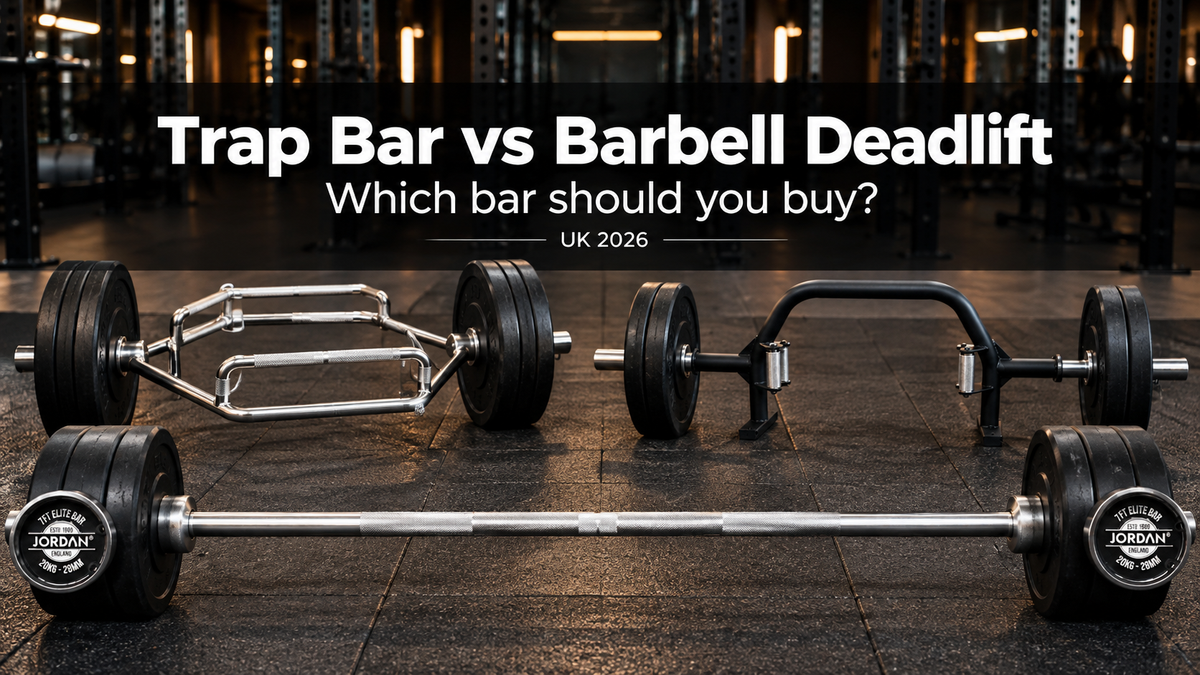
Trap Bar vs Barbell Deadlift UK (2026): Which Bar Should You Buy?

Trap bar or straight barbell is the usual next question once a home gym has a rack and plates. Both train the deadlift, but they load your body differently, and the right buy depends on what you want the lift to do.
The short answer: buy a trap bar if the deadlift is there to build general strength and power with less load on the lower back, or if you coach beginners and athletes. Buy a straight Olympic barbell first if you want one bar for squats, presses and rows as well, or if you compete in powerlifting. In research on trained lifters, the trap bar produced lower lower-back loading and higher force, speed and power, while maximal strength was similar or higher. Our trap bars cost £228 and £336; a straight Jordan bar starts at £162.
Key takeaways
- A trap bar moves work from the lower back to the knees. In a 2011 study of 19 powerlifters, the hexagonal bar produced lower peak moments at the lumbar spine, hip and ankle and a higher peak moment at the knee.
- Most lifters pull at least as much with a trap bar. The same study recorded maximal lifts of about 265kg with the hexagonal bar against 245kg with a straight bar; a 2016 study of 20 trained men found the two almost identical (181.1kg and 181.4kg).
- The straight bar trains the back of the body harder. In the 2016 study, hamstring and lower-back muscle activity was higher with the straight bar, and thigh (quadriceps) activity was higher with the trap bar.
- Buy the straight bar first if you can only have one. It also does squats, presses and rows; a trap bar is a deadlift, shrug and carry tool.
- Closed or open trap bar is a carries decision. The JORDAN Steel Series Hex (Trap) Bar costs £228; the JORDAN Half Hex Trap Bar costs £336 and lets you walk out of the frame for lunges and carries.
What is the difference between a trap bar deadlift and a barbell deadlift?
Where the weight sits. With a straight barbell the load is in front of your shins, so your hips and lower back work to hold the bar close. With a trap (hex) bar you stand inside the frame and hold neutral handles at your sides, so the load lines up with your centre of mass.
That small change alters the lift. You can sit lower with a more upright torso, the knees bend more, and the bar no longer has to travel around your knees on the way up.
| Trap (hex) bar deadlift | Straight barbell deadlift | |
|---|---|---|
| Where the load sits | Either side of you, in line with your body | In front of your shins |
| Grip | Neutral, palms facing in | Overhand, mixed or hook grip |
| Torso angle | More upright | More forward lean |
| Joint loading (Swinton et al., 2011) | Lower at lumbar spine, hip and ankle; higher at the knee | Higher at lumbar spine and hip |
| Muscle emphasis (Camara et al., 2016) | More quadriceps | More hamstrings and lower back |
| Learning curve | Short | Longer; bar path takes coaching |
| Other lifts with the same bar | Shrugs, farmer's carries, jumps | Squats, presses, rows, Olympic lifts |
| Our price | From £228 | From £162 |
Is the trap bar deadlift safer for your lower back?
It puts less load on it, which is what most people mean by safer. In Swinton and colleagues' 2011 study in the Journal of Strength and Conditioning Research, 19 male powerlifters deadlifted with both bars at 10% to 80% of their one-rep max. The hexagonal bar produced lower peak moments at the lumbar spine, hip and ankle, and a higher peak moment at the knee.
So the trap bar shares the work differently rather than removing it. It suits lifters whose lower back is the limiting factor, and is a less obvious fit for anyone whose knees complain under deep, loaded bending.
Neither bar is safe with poor technique or too much weight. If you have a back or knee problem, get advice from a physiotherapist or qualified coach before choosing.
Can you lift more with a trap bar than a barbell?
Usually as much, often more. In the Swinton study, lifters handled about 265kg with the hexagonal bar against about 245kg with the straight bar, and peak force, speed and power were all significantly higher with the hexagonal bar across the submaximal loads.
Camara and colleagues found something more modest in 2016. Testing 20 men with at least a year of deadlifting experience, they recorded one-rep maxes of 181.1kg with the hexagonal bar and 181.4kg with the straight bar, a difference that was not significant (Camara et al., Journal of Strength and Conditioning Research, 2016).
The same study still found higher peak force (2,553N against 2,510N), peak power (1,871W against 1,640W) and peak bar speed (0.81m/s against 0.73m/s) with the hexagonal bar. Camara's team suggested the hexagonal bar may be more effective for developing maximal force, power and speed, which matters for athletes who need to produce force quickly.
Which muscles does each deadlift work?
Both train the legs, hips, back and grip. The difference is emphasis, measured in the Camara study with surface electromyography (EMG):
- Trap bar: higher quadriceps (vastus lateralis) activity in both the lifting and lowering phases.
- Straight bar: higher hamstring (biceps femoris) activity when lifting, and higher lower-back (erector spinae) activity when lowering.
The authors concluded that the two bars produce different patterns of muscle activation. If building the hamstrings and lower back is the goal, the straight bar does more of that job; if you want a heavy pull that also trains the thighs, the trap bar does.
Both count towards the strength work the NHS physical activity guidelines recommend on at least 2 days a week, working all the major muscle groups.
Which bar should you buy first?
A straight Olympic barbell, for almost everyone. It is the bar for squats, bench and overhead presses, rows and the conventional deadlift, so it covers a full programme on its own.
Add a trap bar as the second bar. Buy it first only in three cases: your training is built around deadlifts, carries and jumps rather than pressing; you coach beginners or athletes who need a quick-to-learn heavy pull; or a straight-bar deadlift aggravates your lower back.
| Your situation | Buy | Price |
|---|---|---|
| First bar for a home gym with a rack | JORDAN Steel Series Straight Olympic Bars With Bearings | £162 – £264 |
| Heavy deadlifts, powerlifting, buy once | JORDAN Elite Steel High Performance Olympic Bar | From £276 |
| Deadlifts, shrugs and static holds with less lower-back load | JORDAN Steel Series Hex (Trap) Bar | From £228 |
| Walking carries, lunges, a busy gym floor | JORDAN Half Hex Trap Bar | From £336 |
A straight Elite Steel bar and a closed hex bar together cost £504. Every Jordan bar is compared in our Jordan Olympic bars guide, and the best barbells UK guide covers Olympic, fixed and speciality bars across brands.
 JORDAN Steel Series Straight Olympic Bars With Bearings£162 – £264View product →
 JORDAN Elite Steel High Performance Olympic BarFrom £276View product →
Closed hex bar or open trap bar?
Closed, unless you will use the open end. The two trap bars we sell do the deadlift equally well; they differ in what else you can do and how easily you load them.
| JORDAN Steel Series Hex (Trap) Bar | JORDAN Half Hex Trap Bar | |
|---|---|---|
| Frame | Closed hexagon | Open at one end, so you can walk out |
| Overall length | 1830mm | 2013mm (approx.) |
| Bar weight | 27.5kg | 27kg |
| Handle diameter | 25mm | 28mm and 50mm grips |
| Loadable sleeve | 245mm, 50mm diameter | 380mm, 50mm diameter |
| Load rating (Jordan) | Tested loaded capacity 317.5kg | Tested to hold up to 1,000kg |
| Loading jack | No | Integrated, with rubber feet |
| Our price | £228 | £336 |
Specifications are from Jordan Fitness's product pages for the Steel Series Hex Bar (6ft version, as we sell it) and the Half Hex Trap Bar.
Two numbers matter most. The closed bar's 245mm sleeves hold fewer plates, so strong lifters using thick plates should check how much they can fit. And its 317.5kg load rating is plenty for most home lifters but not for an elite deadlifter, who should choose the Half Hex.
 JORDAN Steel Series Hex (Trap) BarFrom £228View product →
 JORDAN Half Hex Trap BarFrom £336View product →
Does a trap bar need a rack or extra space?
No rack, but more floor. A trap bar deadlift starts from the floor, so it needs only a platform or heavy flooring and room to stand inside it.
Allow for its width. The closed hex bar is 1830mm long with 600mm between the handles, and you need space to step in and out and to load plates at each end. A straight Elite Steel bar is 2210mm long, according to Jordan's specification, so it needs more length but less depth.
Storage is the other difference. A straight bar sits in a rack or a vertical holder; a trap bar is awkward to hang and usually stands on its end or leans against a wall. Plates and storage are covered in our weight plates guide, and rack choice in the best power rack guide.
How are barbells and trap bars delivered?
The JORDAN Half Hex Trap Bar and the 7ft Steel Series bar cost £250 or more, so UK mainland delivery on them is free. The JORDAN Steel Series Hex (Trap) Bar costs £228, so on its own it pays £20 delivery; add plates or a straight bar to reach £250 or more and the whole order ships free.
Orders are dispatched within 5 working days, with tracking emailed within 24 hours of dispatch, and delivered across UK mainland by our delivery partners. We do not deliver to Northern Ireland.
Not sure which bar to add next?
Tell us what bar, rack and plates you already own and what you train for, and we will recommend the right bar. Free UK mainland delivery on orders of £250 or more. Business finance through Vercas Financial for UK limited companies and partnerships of four or more partners on orders of £5,000 or more.
Shop speciality bars → Call 0333 880 3211on orders of £250 or more Commercial-grade kit
Jordan, Attack, Nautilus, Concept2 Finance available
business & commercial Rated by UK buyers
read our reviews
Frequently asked questions
Is a trap bar deadlift a real deadlift? Yes. It is a hip-and-knee hinge that lifts a loaded bar from the floor to standing, which is what a deadlift is. It is not the competition lift, though: powerlifting federations use a straight barbell, so if you plan to compete, train the straight-bar deadlift as your main lift and use the trap bar as a variation.
Is a trap bar good for beginners? Usually, yes. The load sits in line with your body and the handles are neutral, so there is less bar path to learn and less to go wrong around the knees. That can make it a simpler way to learn the hinge before moving to the straight bar. Start light and get your technique checked, whichever bar you use.
How much does a trap bar weigh? It depends on the bar, so never assume 20kg. Jordan lists its 6ft Steel Series Hex Bar at 27.5kg and its Half Hex Trap Bar at 27kg. Count that weight when you add up your plates and log your lifts.
Can I use Olympic plates on a trap bar? Yes. Both Jordan trap bars we sell have 50mm sleeves for Olympic plates. The closed hex bar's sleeves are 245mm long against 380mm on the Half Hex, so the closed bar holds fewer plates, particularly thick bumper plates.
Do I still need a straight barbell if I buy a trap bar? For a complete home gym, yes. A trap bar covers deadlifts, shrugs, carries and jumps, but not squats, bench pressing, overhead pressing or rows. A straight Olympic bar from £162 covers those, so most people buy it first and add the trap bar second.
Do you deliver trap bars to Northern Ireland? No. We deliver to UK mainland only. The JORDAN Half Hex Trap Bar ships free; the JORDAN Steel Series Hex (Trap) Bar is £20 to deliver on its own, or free as part of an order of £250 or more. Orders are dispatched within 5 working days, with tracking emailed within 24 hours of dispatch.
Get more guides like this
Join the Pro Gym Essentials list for equipment buying guides, spec comparisons and offers we don't publish on the site.
No spam. Unsubscribe any time.
Pro Gym Essentials — premium home and commercial gym equipment, delivered across UK mainland. Prices taken from our live product pages, 13 October 2026; bar specifications checked against Jordan Fitness's current product pages, 13 October 2026; deadlift research from Swinton et al. (2011) and Camara et al. (2016), Journal of Strength and Conditioning Research; activity guidance from the NHS.