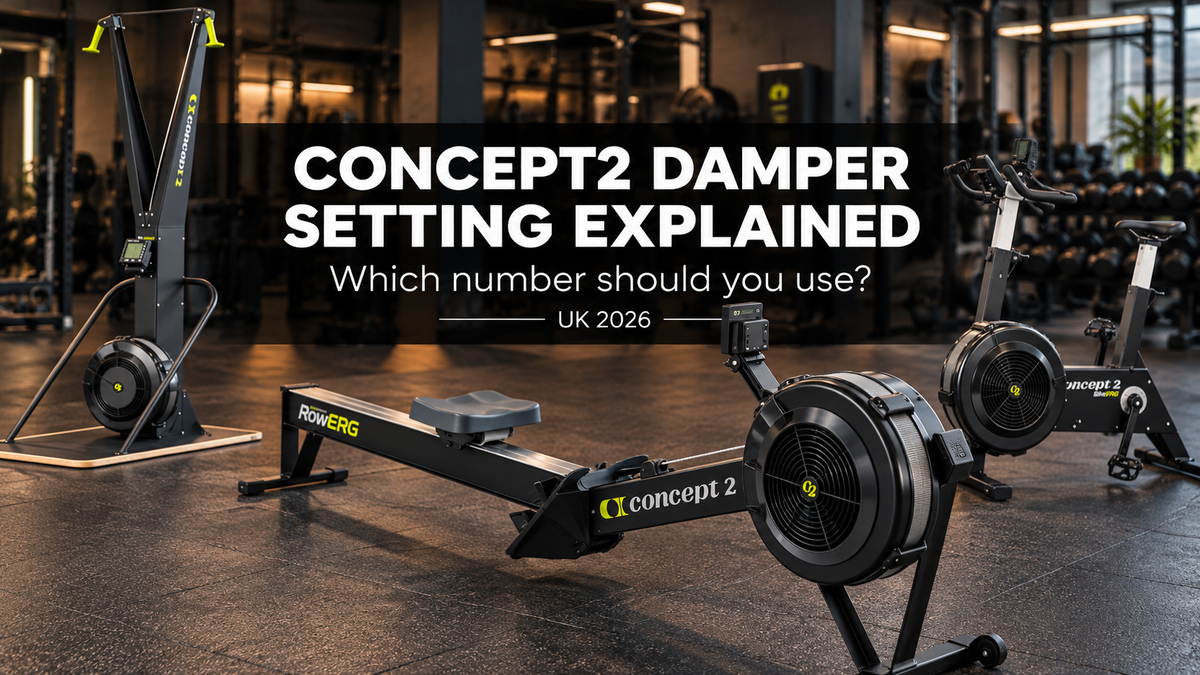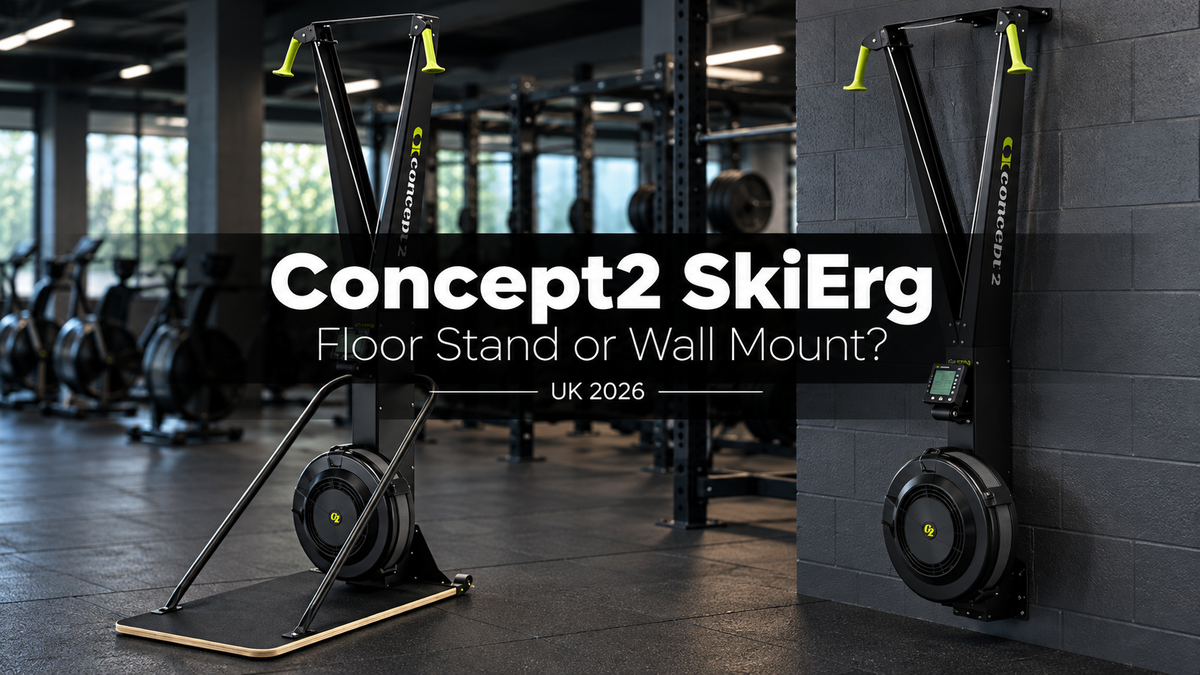

Concept2 Damper Setting Explained (2026): Which Number Should You Use?

The damper is the numbered lever on the side of a Concept2 flywheel housing. It controls how much air reaches the flywheel, which changes how each stroke feels. It does not set how hard the workout is: you do that by how hard you pull, push or pedal.
The short answer: on a RowErg, use a damper of 3 to 5, which is Concept2's own recommendation: around 3 for longer sessions and around 5 for shorter ones. On a SkiErg, start at 3 or lower. On a BikeErg, damper and cadence work together, so pick a setting that lets you hold a comfortable pedalling rate. Whatever the machine, check the drag factor on the PM5 rather than relying on the lever number, because the same number can feel different from one machine to the next.
Key takeaways
- The damper is not a resistance dial. Concept2 compares it with bicycle gearing: it changes how the stroke feels, not the work your effort is credited with.
- Damper 3 to 5 suits most RowErg users. Concept2 recommends 3 for longer workouts, 5 for shorter ones, and says 10 is "rarely (if ever) recommended".
- Start the SkiErg at 3 or lower. Concept2 warns that a damper set too high "can exhaust your muscles".
- Drag factor is the number to compare. On a new RowErg at sea level, Concept2 gives about 90 or less at damper 1 and 200 or more at damper 10.
- Olympic rowers train at moderate drag. Concept2 reports Olympic champion Eric Murray did everything at a drag factor of 130, and two-time Olympic champion Caryn Davies calls 120–135 the "normal" range.
What does the damper on a Concept2 actually do?
It opens and closes the vents into the flywheel housing. Concept2's Damper Setting 101 explains that a higher setting lets more air in, so the flywheel takes more effort to spin and slows down faster between strokes.
A low setting feels light and quick, which Concept2 likens to "a sleek racing shell". A high setting feels heavy and slow, like a bigger, slower boat. Concept2 sums it up: "lower damper settings are best for aerobic workouts, while higher damper settings make rowing more of a strength workout."
The lever runs from 1 to 10 on the RowErg, SkiErg and BikeErg. The number is a position on the vent, not a calibrated unit.
Is a higher damper setting a harder workout?
Not in itself. Concept2 says the damper "is similar to bicycle gearing: it affects how rowing feels but does not directly affect the resistance". The intensity comes from how hard you drive.
The PM5 measures how quickly the flywheel slows between strokes and uses that to credit your real effort "regardless of damper setting". Ten minutes at damper 10 is not automatically harder than ten minutes at damper 3; it is a heavier stroke at a lower rate.
Research shows the setting does change the numbers people produce. In a 2024 pilot study in Studia Sportiva, 56 soldiers rowed 12 minutes at damper 1, 5 and 10. They averaged 2,863m, 2,929m and 3,002m respectively, and the authors found damper 1 matched their 12-minute running test most closely. Pick the setting for the training effect you want, then keep it the same so your results stay comparable.
What damper setting should you use on a RowErg?
Between 3 and 5 for almost every session. Concept2's damper guidance recommends 3 for longer workouts and 5 for shorter ones, and calls 10 "rarely (if ever) recommended".
| Session | RowErg damper | Why |
|---|---|---|
| Long steady rowing, 20 minutes or more | About 3 | A lighter stroke you can repeat for longer |
| General fitness and beginners | 3–5 | Concept2's recommended starting range |
| Short, hard intervals and test pieces | About 5 | A firmer catch for shorter, harder efforts |
| Short maximal power work | Up to 10, briefly | Used by some coaches for specific power sets only |
If your lower back aches after rowing at a high setting, drop the damper before anything else. The tall-leg and standard-leg RowErg share the same flywheel and damper, so the advice is identical for both; our RowErg standard vs tall legs guide covers the difference between them.


What damper setting should you use on a SkiErg?
Start at 3 or lower. Concept2's SkiErg damper guidance says: "Resist setting the damper lever too high; this can exhaust your muscles."
Concept2 describes settings of 1 to 4 as feeling like "faster snow conditions, flats and down hills", and the higher numbers as skiing in slow conditions or uphill. Because the SkiErg works the arms, lats and trunk, a heavy setting fatigues smaller muscles quickly.
The setting is the same whether the SkiErg is wall-mounted or on its floor stand. Our SkiErg floor stand vs wall mount guide covers which version to buy.
How does the damper work on a BikeErg?
Alongside cadence. Concept2's guide to managing resistance says the BikeErg gives you two controls, "the damper setting and your pedaling cadence", and that raising both makes resistance rise "even more quickly".
Cadence has the bigger effect. Concept2 notes that if you pedal twice as fast, "you'll be producing eight times the resistance", because there is no recovery phase on a bike. A moderate damper at a cadence you can hold is a better starting point than a high damper at a slow grind.
The BikeErg also behaves differently on the monitor. Concept2 says the RowErg and SkiErg recalculate drag factor on every stroke, while the BikeErg needs occasional calibration. More on the bike itself is in our BikeErg buyer's guide.
What is drag factor, and why does it matter more than the damper number?
Drag factor is the PM5's measure of how quickly the flywheel slows, which is the real "feel" of the machine. Concept2 says it is "a much better comparison between machines that have different air flows" than the lever position.
| Machine | Drag factor at damper 1 | Drag factor at damper 10 | Our price |
|---|---|---|---|
| Concept 2 RowERG | About 90 or less | 200 or more | From £1,095 |
| Concept 2 SkiERG | About 55 or less | 150 or more | From £909 |
| Concept 2 BikeERG | About 45 or less | 225 or more | From £1,289 |
Figures are Concept2's typical ranges for a brand-new machine at sea level, from its viewing drag factor guide. The numbers differ between machines, so a RowErg drag factor cannot be compared with a SkiErg or BikeErg one.
What drag factor do Olympic rowers use?
Mostly between about 110 and 140, well short of the maximum. Concept2's article The Damper and Drag of Olympians asked champions and coaches for their numbers.
| Rower or coach | Drag factor | Context |
|---|---|---|
| Eric Murray, New Zealand | 130 | 2012 and 2016 Olympic champion, men's pair |
| Caryn Davies, USA | About 125 | Two-time Olympic champion, women's eight; calls 120–135 normal |
| Gevvie Stone, USA | About 112 | 2016 Olympic silver medallist, women's single |
| Todd Kennett, Cornell | 140 | Heavyweight head coach, for long steady-state work |
Davies describes damper 10 for general training as "a recipe for injury". The lesson for a home or gym user is simple: elite rowers prefer a moderate drag and keep it consistent, and so should you.
How do you check drag factor on the PM5?
From the main menu, select More Options, then Display Drag Factor, and start rowing, skiing or riding. The PM5 shows the figure after a few seconds.
Move the damper while you watch the number until you reach your target, then note the lever position for that machine. Our Concept2 PM5 monitor guide covers the rest of the monitor: units, heart rate straps, apps and firmware.
Why does the same damper number feel different on another machine?
Because airflow varies. Concept2 says machines differ "due to things such as dust in the flywheel or elevation", and that "a damper setting of 3 on your home machine may feel like 4 on the machine at the gym."
Dust builds up inside the flywheel housing over time and reduces airflow, so an older or unserviced machine can feel lighter at the same setting. Altitude changes air density too, although that matters little across most of the UK.
If a familiar setting suddenly feels different, check the drag factor before changing your training. Keeping the flywheel housing clean is part of routine care, and the PM5 still credits your true effort whatever the setting.
What damper setting should a commercial gym use?
Pick a drag factor rather than a lever number, and set every machine to it. On a bank of RowErgs, that means members get the same feel on any machine, and their scores compare from one session to the next.
Write the target drag factor on a card by the machines, coach members to watch their pace rather than the lever, and recheck after cleaning. The HSE expects work equipment that is exposed to wear to be inspected at intervals set by your risk assessment, and a drag factor check is a quick addition to that routine.
For how many ergs a floor needs, see our commercial cardio floor plan guide, and for the right mix of machines, our RowErg vs BikeErg vs SkiErg guide.


How are Concept2 machines delivered?
Free UK delivery on the Concept 2 RowERG, SkiERG, BikeERG and The Concept 2 Triple. Orders are dispatched within 5 working days, with tracking emailed within 24 hours of dispatch, and delivered across UK mainland by our delivery partners. We do not deliver to Northern Ireland.
You can choose courier delivery to self-assemble, pre-assembled delivery, or full installation arranged on site, quoted separately before ordering.
Not sure which Concept2 suits your training?
Tell us how you train and the room the machine is going in, and we will recommend the right erg. Free UK mainland delivery on orders of £250 or more. Business finance through Vercas Financial for UK limited companies and partnerships of four or more partners on orders of £5,000 or more.
Shop Concept2 machines → Call 0333 880 3211on orders of £250 or more Commercial-grade kit
Concept2, StairMaster, Jordan Finance available
business & commercial Rated by UK buyers
read our reviews
Frequently asked questions
Will a higher damper setting burn more calories? Not by itself. The PM5 credits the work you actually do, whatever the lever position, so calories follow your effort. A heavy setting can make each stroke feel harder, but many people tire sooner and produce less over a full session. Most users get more from a damper of 3 to 5 with a strong, consistent drive.
Is damper 10 bad for you? It is not dangerous for a short, deliberate power set, and some coaches use it that way. For general training, Concept2 says 10 is "rarely (if ever) recommended", and Olympic champion Caryn Davies calls it "a recipe for injury". The slow, heavy stroke loads the lower back, especially when technique slips late in a session.
Why does my home RowErg feel lighter than the one at the gym? Airflow differs between machines, mainly because of dust in the flywheel housing. Concept2 notes that damper 3 at home may feel like 4 at the gym. Check the drag factor on both machines with the PM5 and set the lever to match the number, not the position.
Should beginners use a low or high damper? Low to moderate. Concept2 recommends starting the RowErg at 3 to 5 and the SkiErg at 3 or lower. A lighter setting lets you learn the sequence of legs, body and arms without straining, and you can add intensity by driving harder rather than moving the lever.
Do I need to change the damper for intervals? You can, but you do not have to. Concept2 suggests around 5 for shorter workouts and around 3 for longer ones. Many people keep one setting for everything so their results compare from session to session, and change only their effort.
Does the damper setting affect my scores on the Concept2 Logbook? No. The PM5 calculates your pace and watts from the flywheel's real deceleration, so a 2,000m time is credited the same way at any damper position. Results are ranked within each machine category, so RowErg scores are compared with other RowErg scores, and SkiErg and BikeErg results are ranked separately rather than against each other.
Get more guides like this
Join the Pro Gym Essentials list for equipment buying guides, spec comparisons and offers we don't publish on the site.
No spam. Unsubscribe any time.
Pro Gym Essentials — premium home and commercial gym equipment, delivered across UK mainland. Prices and delivery taken from our live product pages, 15 October 2026; damper and drag factor guidance checked against Concept2's current RowErg, SkiErg and BikeErg support pages, 15 October 2026; athlete drag factors from Concept2's "The Damper and Drag of Olympians"; study data from Kellner et al., Studia Sportiva (2024); inspection guidance from the HSE.