
Concept2 UK: RowErg vs BikeErg vs SkiErg Explained (2026)

Concept2 makes three machines. They look unrelated, they cost within £400 of each other, and they share the same flywheel, the same monitor and the same numbers. That last part is the reason gyms buy them and the reason the comparison confuses people.
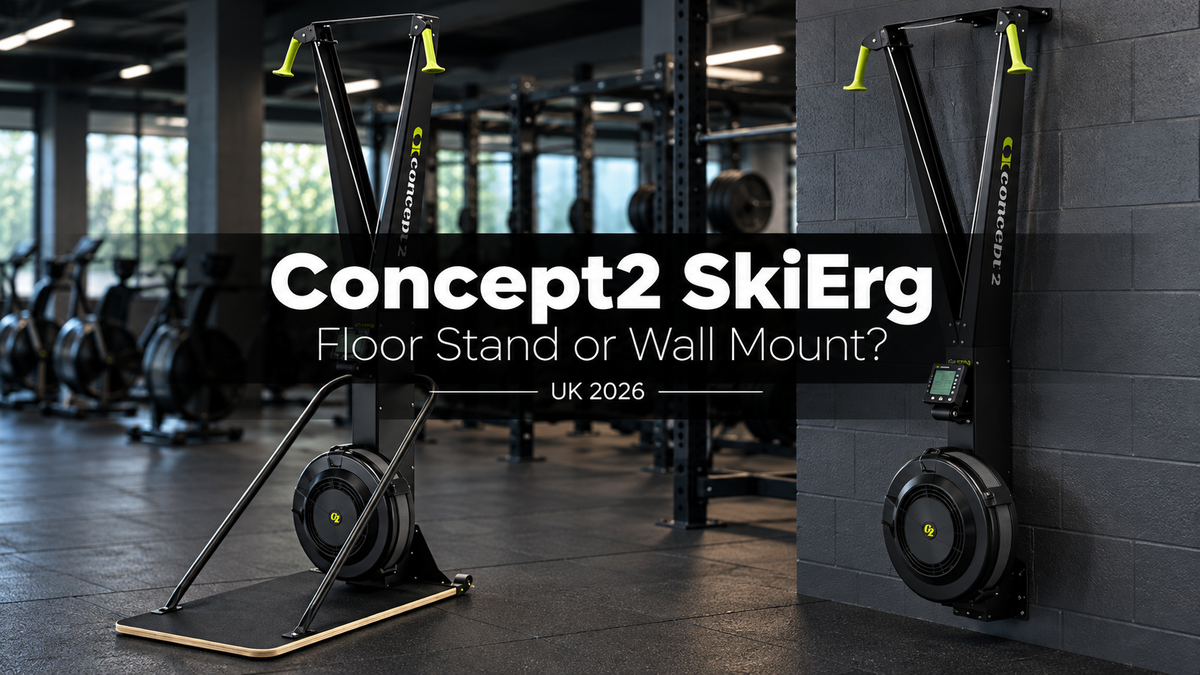
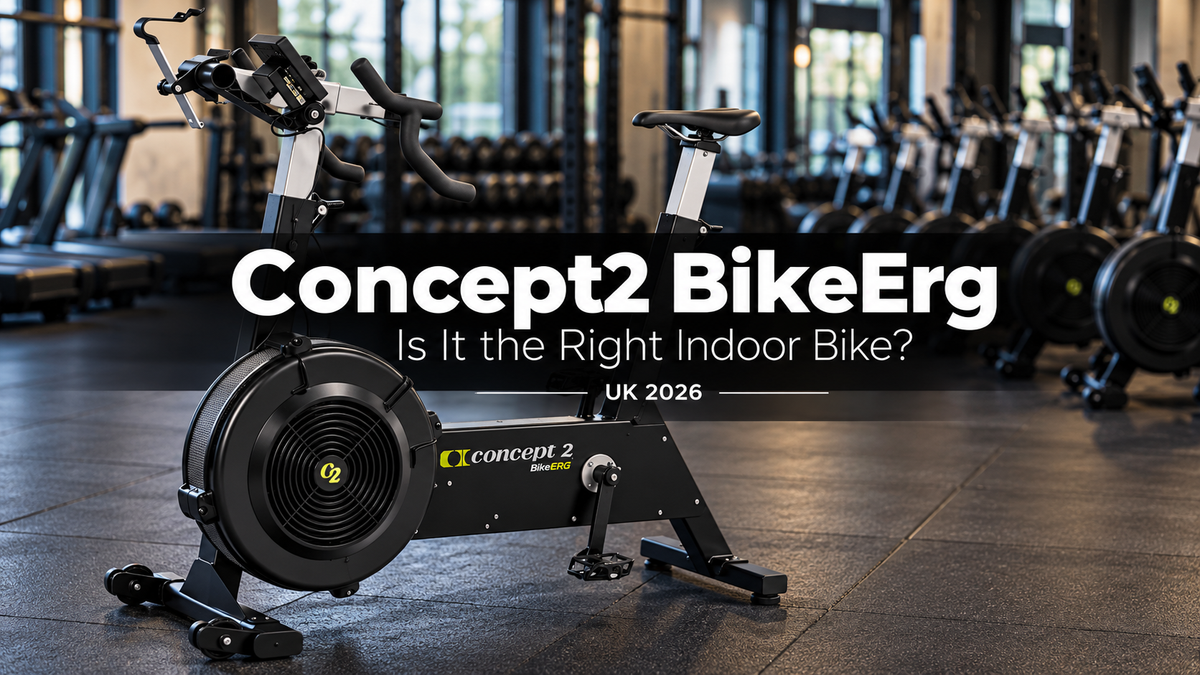
The short answer: the RowErg is the whole-body machine — legs, back and arms, low impact, the most transferable conditioning of the three. The BikeErg is legs only, seated, the easiest to learn and the best choice for long or repeated efforts without frying your grip and shoulders. The SkiErg is upper body and trunk, takes the least floor space of any of them, and can be wall-mounted. All three run the same PM5 monitor and the same air-braked flywheel, so a watt is a watt across the set — and comparable to every other Concept2 in the world.
Key takeaways
- One monitor across three machines. The PM5 means your RowErg, BikeErg and SkiErg data is directly comparable — the single biggest reason clubs and coaches standardise on Concept2 rather than mixing brands.
- UK prices verified live on 25 August 2026: SkiErg from £909, RowErg from £1,095, BikeErg £1,289.
- The SkiErg at £909 is the cheapest commercial-grade cardio machine in our entire 39-machine cardio catalogue. Only five of those machines come in under £1,300 — and three of the five are the Concept2 ergs.
- The damper is not a resistance dial. Concept2's own guidance: "We recommend starting out on a damper setting of 3–5." Intensity comes from how hard you pull, not the lever.
- The 2026 World Rowing Indoor Championships, presented by Concept2, are at the NEC Birmingham on 5–6 December 2026. If you are buying an erg to train for it, the clock is already running.
What is the difference between the RowErg, BikeErg and SkiErg?
Muscle groups and footprint. The resistance mechanism and the monitor are identical, so everything that separates them is about what your body does and how much room the machine takes.
| RowErg | BikeErg | SkiErg | |
|---|---|---|---|
| Primary muscles | Legs, back, arms — roughly 60% legs | Legs only | Lats, triceps, trunk, some legs |
| Impact on joints | Very low, seated and supported | Very low, seated | Low, standing |
| Learning curve | Real — the sequence takes coaching | Almost none | Short |
| Floor space | Largest — needs clear length behind | Compact, bike footprint | Smallest; wall-mountable |
| Storage | Separates into two pieces | Stays assembled | Wall bracket or floor stand |
| Best for | General conditioning, most transferable | High volume, leg work, recovery sessions, rehab | Upper body conditioning, small rooms, circuits |
| UK price from | £1,095 | £1,289 | £909 |
The practical read: if you can only have one and you want the most conditioning per session, take the RowErg. If knees, hips or a rehab plan rule out loaded movement, take the BikeErg. If the room is genuinely tight, take the SkiErg — it is the only one of the three that goes on a wall.
Kit for this: the RowErg and BikeErg are the two that most home buyers are actually choosing between. Legs-plus-upper-body versus legs-only is the whole decision.


Which Concept2 erg should you buy?
Pick by the job, not by the brochure. Here is how we route the question when someone calls.
- "I want one machine that does the most for me." RowErg. It is the only one of the three that trains legs, back and arms in one movement, which is why it is the default in almost every strength and conditioning room.
- "My knees or back can't take much." BikeErg. Seated, supported, no loading through the spine, and the resistance is entirely self-selected.
- "I already squat and deadlift — I want conditioning that doesn't fight my legs." SkiErg. Upper body and trunk, so it slots into a strength week without stealing recovery from your leg days.
- "The room is 2.5 by 2.5 metres." SkiErg on the wall bracket, or a BikeErg. A RowErg will fit but will dominate the room.
- "It's for a gym floor with mixed members." All three, in that order of quantity. Rowers get used most, bikes suit deconditioned and returning members, and the SkiErg is the one people queue for in a circuit class.
One caveat worth saying out loud: the RowErg has a genuine technique requirement. Legs, then back, then arms, and the reverse on the recovery. Rowed badly it is a lower-back irritation rather than a conditioning tool, so budget an hour of coaching or a decent video before you commit to a programme.
How much do Concept2 ergs cost in the UK?
£909 to £1,289 depending on machine and configuration. Every option we list, verified live on 25 August 2026:
| Machine | Configuration | Price | Why you'd choose it |
|---|---|---|---|
| SkiErg | Without floor stand | £909 | Wall-mounted — the cheapest commercial-grade cardio we stock |
| SkiErg | With floor stand | £1,187 | Free-standing, no wall drilling, movable |
| RowErg | Standard legs | £1,095 | The standard home and gym machine |
| RowErg | Tall legs | £1,285 | Higher seat — easier on and off for taller or less mobile users |
| BikeErg | Single configuration | £1,289 | No options to weigh up |
For context on where that sits in the market, our cardio catalogue runs to 39 machines and tops out at £8,895 for a stepmill. Only five of those machines are under £1,300, and three of the five are these ergs. Concept2 is not the cheap option because it is a lesser machine — it is cheap because it is a simple one, with no motor, no incline mechanism and no touchscreen to fail.
What is the damper setting, and is it the same as resistance?
No — and this is the single most misunderstood thing about a Concept2. The damper is airflow, not difficulty.
Concept2 describes it plainly: "The damper is the lever on the side of the flywheel housing, or fan cage, that controls how much air flows into the cage." More air makes the flywheel harder to spin and slower to decelerate; less air makes it easier.
What actually sets the intensity is you. In Concept2's words, "The intensity of your workout is controlled by how much you use your legs, back and arms to move the handle — in other words, how hard you pull."
The number that matters is drag factor, which the monitor calculates for you: "Between each stroke, the PM measures how much your flywheel is slowing down to determine how sleek or slow your 'boat' is. This rate of deceleration is called the drag factor." Because the PM5 works from drag factor, your split is a true measure of effort "regardless of damper setting".
Concept2's recommendation for most people is a damper of 3–5 (Concept2 training guidance). Setting it to 10 and grinding does not make you fitter; it makes the stroke heavier and slower, and it is the fastest route to an irritated lower back.
Practical version for a gym floor: set the damper to 4, leave it there, and coach members to watch their split instead of the lever.
Do you need the tall legs on a RowErg or the floor stand on a SkiErg?
Tall legs if getting up off the floor is hard work; the floor stand if you cannot or will not drill the wall. Both are practical choices, not performance ones.
The RowErg's standard legs put the seat low, which is fine for most people and slightly better for a long, powerful leg drive. The tall-leg version raises the seat and costs £190 more. It is worth it for taller users, older users, anyone with a hip or knee restriction, and any facility where members will otherwise struggle to get on and off — which in a mixed-membership gym is a real proportion of them.
The SkiErg splits the same way. Wall-mounted at £909 it is the smallest-footprint cardio machine you can buy and it never moves. On the floor stand at £1,187 it stands alone, can be repositioned for classes, and suits a rented unit or a room you cannot drill.
The £278 difference between the two SkiErg configurations is almost entirely the stand. If the machine is going in one place permanently, wall-mount it and put the difference towards something else.


How much space does a Concept2 erg need at home?
More length than people plan for on the RowErg, and almost none on the SkiErg. This is the question that decides which one goes in a spare room.
From fitting these into UK homes, the working numbers we give people are:
- RowErg: plan on roughly 2.5m of clear length and about 1.2m of width. It separates into two pieces for storage, and the front section stands upright in a corner — but you still need the 2.5m every time you use it.
- BikeErg: a bike footprint plus room to get on and off. Roughly 1.5m × 1m of usable space, and it does not need to be moved.
- SkiErg: wall-mounted it takes essentially no floor area, but you need clear ceiling height above the handles and about a metre of standing room in front. On the floor stand, allow around 1.2m × 1m.
Two things that catch people out regardless of machine. Air-braked flywheels are loud — noticeably louder than a magnetic bike, which matters in a flat or a shared wall. And they move a lot of air, so a small, unventilated room gets warm fast.
If the room is the constraint rather than the budget, our small-space home gym guide covers layout, and the best home cardio machine guide compares the ergs against treadmills and bikes.
Are Concept2 ergs good enough for a commercial gym?
Yes — they are among the most heavily used machines on any commercial floor, and the reason is what is not in them.
There is no motor, no incline mechanism, no drive belt under load and no touchscreen. The wear parts are a chain, a set of bearings, a shock cord and the monitor batteries. That is why an erg in a busy club is still working after years of use that would have finished a mid-range treadmill.
The relevant standard is ISO 20957-1:2024, which defines Class S equipment as that "intended for use in training areas of organizations such as sport associations, educational establishments, hotels, clubs and studios, where access and control are specifically regulated by the owner", separately from Class H for private homes. Ask any supplier which class a machine is declared to before you fit out a facility.
There is also a duty attached once members are using the equipment. The HSE requires inspection under PUWER regulation 6 after installation and before first use, at intervals set by your own risk assessment, and after any exceptional event such as suspected damage. On an erg the things to actually check are the chain, the shock cord tension and the seat rollers.
Why do UK gyms and clubs standardise on Concept2?
Because the data is comparable, and because the competitive calendar is built on it.
Every Concept2 uses the PM5, and every PM5 calculates from drag factor. That means a 2,000m time on your machine means the same as a 2,000m time on a machine in another gym, another country or a national trial. No other cardio brand gives you that across three different modalities.
That standardisation is why the sport itself runs on them. World Rowing announced that the 2026 World Rowing Indoor Championships, presented by Concept2, will be held at the National Exhibition Centre in Birmingham on 5–6 December 2026, alongside the British Rowing Indoor Championships. Vincent Gaillard, World Rowing's Executive Director, said the federation was "thrilled to see the World Rowing Indoor Championships returning to in-person", and British Rowing chief executive Tom Solesbury called the British championships an event that "has gone from strength to strength" (World Rowing).
For a UK buyer that is more than trivia. It means a machine bought this month is the same machine you will race on in December, and British Rowing's indoor rowing programme gives you a structured route from a spare-room erg to a competition entry.
It also explains the resale market. Concept2 machines hold value better than almost any cardio equipment, precisely because the standardisation makes a used one a known quantity.
What else should you look at if a Concept2 is not right?
Three sensible alternatives, depending on why the erg does not fit.
If you want a rower with a different feel and a heavier build, the TRUE RŌ Rower at £2,394 is the commercial-floor alternative. It costs more than twice a RowErg and is aimed at facilities specifying a full TRUE cardio bank rather than at home buyers.
If you want the hardest possible conditioning in the smallest time, an air bike does what a BikeErg will not — it works arms and legs simultaneously against unlimited resistance. The Attack Air Attack at £1,160 sits almost exactly at BikeErg money.
If you want structured interval work with a console that drives it, the StairMaster HIIT Bike at £1,640 and the Wattbike AtomX at £3,198 are the two we get asked about most. The Wattbike in particular is the machine for anyone training with power on a bike rather than just doing cardio.
Our commercial cardio brands guide compares all of these across the whole catalogue, and spin bike vs air bike covers the bike question specifically.


Training for Birmingham in December?
Free UK delivery on orders over £250. Finance available for business and commercial buyers. Talk to someone who has fitted these into UK homes and gym floors before you choose a configuration.
Shop rowing machines → Call 0333 880 3211on orders over £250 Commercial-grade kit
Concept2, StairMaster, Star Trac Finance available
business & commercial Rated by UK buyers
read our reviews
Frequently asked questions
Is the RowErg the same as the old Model D? Yes — Concept2 renamed the Model D as the RowErg. It is the same machine family, the same air-braked flywheel and the same PM5 monitor. If you see a Model D referenced in a training plan or a world record, it applies directly to a current RowErg.
Which is harder, the RowErg or the BikeErg? Neither, and that is the point — both are self-limiting, so the intensity is whatever you generate. In practice most people can hold a higher wattage for longer on the BikeErg because it uses only the legs, while the RowErg fatigues grip, back and shoulders alongside the legs and so feels harder at the same duration.
Can I put a SkiErg on a plasterboard wall? Not on plasterboard alone. The wall bracket needs fixing into structural timber, masonry or a properly specified backing board, because the load is dynamic and pulls downward and outward. If the wall is not suitable, the floor stand version at £1,187 solves it without any drilling.
Do I need the PM5 monitor, or is there a cheaper display? The PM5 is the monitor on all three machines — there is no cheaper option, and you would not want one. It is what makes the data comparable, connects to Bluetooth and ANT+ for heart rate and apps, and records to the Concept2 online logbook.
How loud is a Concept2 erg? Loud enough to matter in a flat. Air resistance means a rushing fan noise on every stroke that rises with effort, and it carries through floors. Rubber matting underneath helps with the structural transmission but not the airborne noise. If noise is the deciding factor, a magnetic indoor cycle is quieter than any air-braked machine.
Are they worth it for a commercial gym compared with a treadmill? Per pound of purchase and per hour of maintenance, comfortably. An erg has no motor, no incline actuator and no running belt to replace, so the ongoing cost is a chain, a shock cord and bearings. A commercial treadmill costs three to six times as much up front and considerably more to keep running — which is why most gyms buy a bank of ergs and fewer treadmills than members ask for.
How are they delivered, and do they need assembly? They arrive boxed and need modest assembly — typically bolting the front section to the rail and fitting the monitor arm, well within DIY territory in under an hour. Tell us at the point of order if it is going upstairs, because a RowErg box is long rather than heavy and stairwell turns are the usual problem.
Ready to choose your erg?
One machine for the most conditioning: RowErg. Legs only, or joints that need looking after: BikeErg. Smallest room or a strength-led week: SkiErg.
Browse the rowing machines, ski trainers and exercise bikes we stock, or see the whole picture in our commercial cardio brands guide. Not sure which configuration? Call 0333 880 3211 or use the contact form and we will size it against your room.
Get more guides like this
Join the Pro Gym Essentials list for equipment buying guides, spec comparisons and offers we don't publish on the site.
No spam. Unsubscribe any time.
Pro Gym Essentials — premium home and commercial gym equipment, delivered across the UK. Prices verified 25 August 2026.