
Commercial Exercise Bikes UK (2026): Spin, Upright, Recumbent and Air

A commercial exercise bike is built for many riders a day, every day. Its frame, bearings, resistance system and warranty are designed for a shared floor where nobody looks after the machine between sessions.
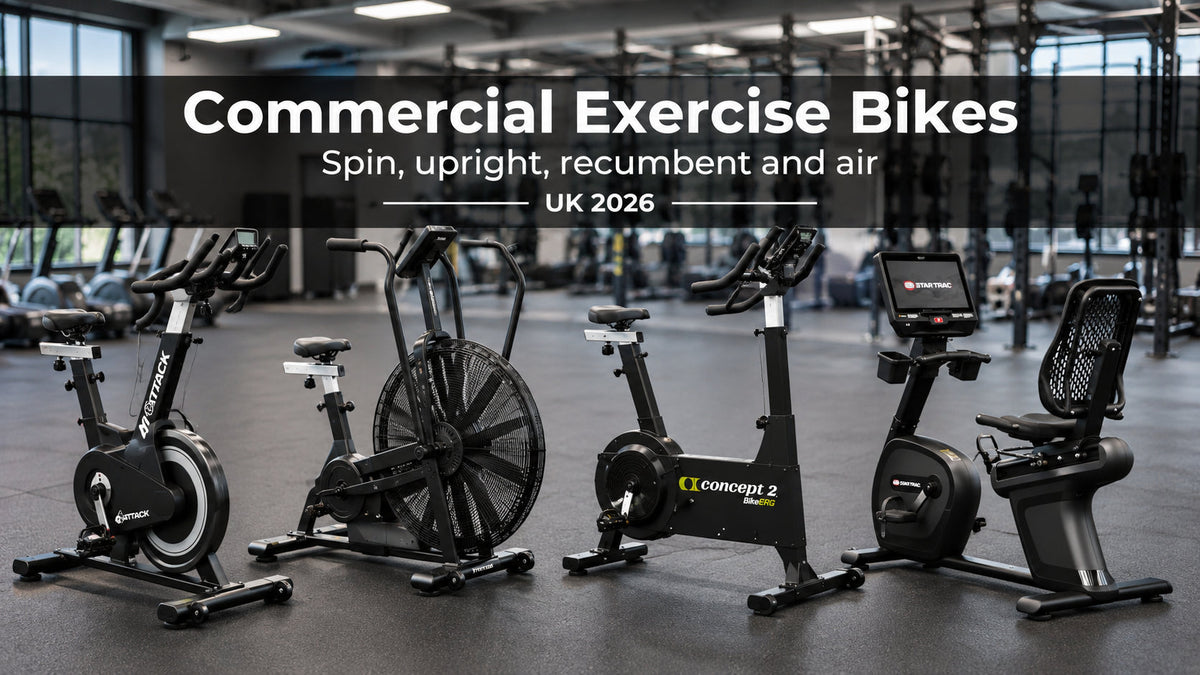
The short answer: most gyms need a mix of types. Use indoor cycles (spin bikes) for classes, upright and recumbent bikes for steady cardio and members who want an easy seat, and air bikes for intervals and conditioning. At Pro Gym Essentials, priced commercial bikes run from £1,060 for the Attack Fitness Spin Attack B1 to £2,394 for the TRUE ADX Fan Bike. Star Trac upright and recumbent bikes are supplied on quote.
Key takeaways
- There are four main types of commercial exercise bike: indoor cycles for classes, upright bikes, recumbent bikes for low-impact work, and air bikes for intervals.
- Commercial bikes are tested to their own standard. ISO 20957-5 sets the safety requirements and test methods for stationary exercise bicycles, within the class system of the ISO 20957 series.
- The market is growing. LeisureDB's 2025 State of the UK Fitness Industry Report counted 7,202 gyms open in the UK at the end of March 2025, up from 7,009 a year earlier.
- Magnetic resistance suits busy class studios because it is near silent and has no brake pad to wear out. Friction resistance is simpler and cheaper but needs pad replacement.
What makes a commercial exercise bike different from a home bike?
Duty cycle is the main difference. A home bike might be ridden for an hour a day by one or two people. A gym bike can be in use from opening to closing by riders of every size, many of whom adjust the seat and handlebars badly and pedal out of the saddle.
So commercial frames are heavier and stiffer, bearings are sized for constant load, and wear parts are quick to swap.
The standard behind this is ISO 20957-5:2016, which adds specific safety requirements and test methods for stationary exercise bicycles to the general rules in ISO 20957-1. It applies to equipment in classes S, H, I and A, B, C, as defined in ISO 20957-1. Ask for the classification and the maximum user weight on any bike you shortlist.
Which types of commercial exercise bike are there?
Choose by mechanism and by who will ride it. Each type does a different job, which is why most facilities buy more than one.
| Type | How resistance works | Best for | Riding position |
|---|---|---|---|
| Indoor cycle (spin bike) | Weighted flywheel with a magnetic or friction brake, set by a lever | Group classes, structured seated and standing sessions | Road-bike style, forward lean |
| Upright bike | Set from the console | Steady cardio, warm-ups, programmed workouts | Upright, saddle under the hips |
| Recumbent bike | Set from the console | Low-impact cardio, rehabilitation, older members | Reclined seat with a backrest, step-through frame |
| Air bike (fan bike) | A fan: the harder you pedal and push, the more air it moves | Intervals, conditioning, testing, finishers | Upright, with moving arm handles |
| Air-resistance cycle (Concept2 BikeERG) | Air flywheel with an adjustable damper | Measured endurance and power work | Road-bike style, fixed bars |
For a deeper look at the two most common conditioning choices, read our guide to spin bike vs air bike.
What should you look for in a commercial spin bike?
Start with the resistance system. A commercial spin bike uses either a friction brake pad on the flywheel or magnets that never touch it, and the two age differently on a busy timetable.
- Magnetic resistance is near silent, has no pad to replace and gives repeatable settings. It suits daily class timetables.
- Friction resistance is simpler and cheaper, but the pad wears, so plan for replacements. It suits lighter-use spaces.
- Console and heart rate: check whether the console is included or an extra; coaches will want heart-rate data.
Our two indoor cycles cover both routes. The Attack Fitness Spin Attack M1 uses magnetic resistance and comes with a console and heart-rate strap. The Spin Attack B1 uses friction brake-pad resistance, with a console available separately.
 Attack Fitness Spin Attack M1 Indoor CycleFrom £1,990View product →
 Attack Fitness Spin Attack B1 Indoor CycleFrom £1,060View product →
When does a gym need upright and recumbent bikes?

Almost always. Upright and recumbent bikes serve members who will never join a spin class: beginners, people warming up before weights, and anyone following a steady programme on the console.
Recumbent bikes matter more than many operators expect. The reclined seat and backrest take pressure off the lower back, and a step-through frame makes getting on and off easy, so they suit rehabilitation and older members.
We supply Star Trac upright and recumbent bikes in two tiers. The 4-Series bikes suit hotels, education and corporate gyms, with a choice of LCD Screen, 10" Touch Screen or 15" Touch Screen. The 8 Series bikes are built for high-traffic clubs, with a choice of Apex LED Display or 16" Apex HD Touchscreen, and the 8UB upright is self-generating, so it needs no external power connection. See our Star Trac UK review for the full range.
 Star Trac 8 Series 8UB Upright BikePrice on requestGet a quote →
 Star Trac 8 Series 8RB Recumbent BikePrice on requestGet a quote →
 Star Trac 4-Series 4UB Upright BikePrice on requestGet a quote →
 Star Trac 4-Series Recumbent BikePrice on requestGet a quote →
Which air bike is best for a commercial gym?
Pick by how hard it will be used. All three of ours are self-powered, so they can go anywhere on the floor plan, and resistance rises with effort, so no rider tops out.
- TRUE ADX Fan Bike (£2,394): built for busy gym floors and interval testing, with a 26-blade fan. TRUE's published specification rates it for users up to 160kg.
- StairMaster HIIT Bike (£1,640): dual-action wind resistance, built for shared floors and PT studios.
- Attack Fitness Air Attack Air Bike (£1,160): a steel-fan air bike with dual-action arms, and our most affordable commercial air bike.
The Concept 2 BikeERG (£1,289) sits alongside them. It uses an air flywheel rather than a fan with arms, and its PM5 monitor gives calibrated watts, so results are comparable across sessions and across Concept2 machines. Read our air bike guide and our Concept2 BikeErg buyer's guide for more detail.


 Attack Fitness Air Attack Air BikeFrom £1,160View product →
 Concept 2 BikeERGFrom £1,289View product →
How do our commercial exercise bikes compare?
Prices are from our live product pages. Star Trac bikes are supplied on quote.
| Bike | Type | Resistance | Best for | Price |
|---|---|---|---|---|
| Attack Fitness Spin Attack B1 Indoor Cycle | Indoor cycle | Friction brake pad | Lighter-use studios | £1,060 |
| Attack Fitness Spin Attack M1 Indoor Cycle | Indoor cycle | Magnetic | Daily class timetables | £1,990 |
| Attack Fitness Air Attack Air Bike | Air bike | Steel fan | Intervals on a budget | £1,160 |
| Concept 2 BikeERG | Air-resistance cycle | Air flywheel with damper | Measured power work | £1,289 |
| StairMaster HIIT Bike | Air bike | Dual-action wind | Shared floors, PT studios | £1,640 |
| TRUE ADX Fan Bike | Air bike | 26-blade fan | Busy gym floors, testing | £2,394 |
| Star Trac 4-Series 4UB / 4-Series Recumbent | Upright / recumbent | Console-controlled | Hotels, education, corporate | Price on request |
| Star Trac 8 Series 8UB / 8RB | Upright / recumbent | Console-controlled | High-traffic clubs, rehab | Price on request |
| Star Trac 8VB Virtual Bike | Virtual indoor cycle | Console-controlled | Premium clubs, boutique studios | Price on request |
How many bikes does a commercial gym need?
Work it out from your peak hour, not your membership total: count who is on the cardio floor at your busiest time, then match bike types to those groups.
The NHS physical activity guidelines recommend at least 150 minutes of moderate or 75 minutes of vigorous activity a week, and list cycling under both. Upright and recumbent bikes serve the moderate minutes; spin and air bikes serve the vigorous ones.
- Hotel, office or school gym: one or two upright bikes and a recumbent usually cover it. See our hotel gym equipment guide.
- Mainstream membership gym: a row of upright and recumbent bikes on the cardio floor, plus air bikes in the functional area.
- PT or HIIT studio: air bikes first, then a Concept 2 BikeERG for measurable work.
- Class studio: one indoor cycle per class place, plus an instructor bike.
For layout and spacing across treadmills, stair climbers, rowers and bikes, use our commercial cardio floor plan guide, and our commercial gym equipment list for the whole fit-out.
What maintenance does a commercial exercise bike need?
Regular checks, recorded. Under the Provision and Use of Work Equipment Regulations, the HSE says equipment exposed to conditions that cause deterioration should be inspected at suitable intervals, and after installation where safety depends on it. Results should be kept at least until the next inspection.
- Daily: wipe sweat off frames, saddles and handles, and check that seat and bar adjusters lock.
- Weekly: check pedals and straps, listen for new noises and test the emergency brake on indoor cycles where fitted.
- Periodically: replace brake pads on friction bikes, check belts and bearings, and follow the manufacturer's service schedule.
How are our commercial exercise bikes delivered?
Free UK delivery on every priced bike in this guide. Orders are dispatched within 5 working days, with tracking emailed within 24 hours of dispatch, and delivered across UK mainland by our delivery partners.
You can choose courier delivery to self-assemble, pre-assembled delivery, or full installation arranged on site, quoted separately before ordering. For Star Trac bikes, request a quote and we will confirm the console, delivery and installation options with you.
Business finance through Vercas Financial is available on orders of £5,000 and above, for UK limited companies and partnerships of four or more partners. Three Spin Attack M1 Indoor Cycles (£5,970) would qualify, as would a mixed order of bikes and other equipment.
Fitting out a cardio floor or cycle studio?
Tell us your space, peak-hour numbers and members, and we'll recommend the right mix of bikes. Free UK delivery. Business finance available on orders from £5,000.
Request a quote → Call 0333 880 3211on orders of £250 or more Commercial-grade kit
Star Trac, StairMaster, Concept2, TRUE Finance available
business & commercial Rated by UK buyers
read our reviews
Frequently asked questions
What is the difference between a commercial spin bike and a commercial upright bike? A spin bike, or indoor cycle, has a weighted flywheel, a manual resistance lever and a road-bike position, built for instructor-led classes and standing efforts. An upright bike has an upright seat, console-controlled resistance and programmed workouts for steady solo cardio. Most gyms need both.
Is magnetic or friction resistance better for a gym? Magnetic resistance is better for busy studios. It is near silent, there is no brake pad to wear out, and the settings are repeatable from class to class. Friction resistance costs less to buy and is simple to service, but the pad needs replacing as it wears, so it suits spaces where bikes are ridden a few times a week rather than every day.
Do gym bikes need a power socket? It depends on the bike. Our three air bikes are self-powered, with nothing to plug in, and the Star Trac 8 Series 8UB upright is self-generating. Touchscreen consoles on other models may need mains power, so confirm the requirement for your chosen console before you plan the floor and run cables.
Are recumbent bikes worth having in a commercial gym? Yes, for most facilities. The reclined seat and backrest take load off the lower back, and a step-through frame makes them easy to get on and off. They serve rehabilitation, older members and anyone who finds an upright saddle uncomfortable, a group that spin and air bikes do not serve.
Can I buy commercial exercise bikes on finance? Business finance through Vercas Financial is available on equipment orders of £5,000 and above, for UK limited companies and partnerships of four or more partners. A single bike sits below that, but several bikes, or bikes alongside other equipment on the same order, can qualify. Personal buyers can spread the cost with PayPal Pay in 3 or Shop Pay on our product pages.
Get more guides like this
Join the Pro Gym Essentials list for equipment buying guides, spec comparisons and offers we don't publish on the site.
No spam. Unsubscribe any time.
Pro Gym Essentials — premium home and commercial gym equipment, delivered across UK mainland. Prices taken from our live product pages, 22 November 2026; TRUE ADX user rating from TRUE Fitness's published ADX specification sheet, checked 22 November 2026.