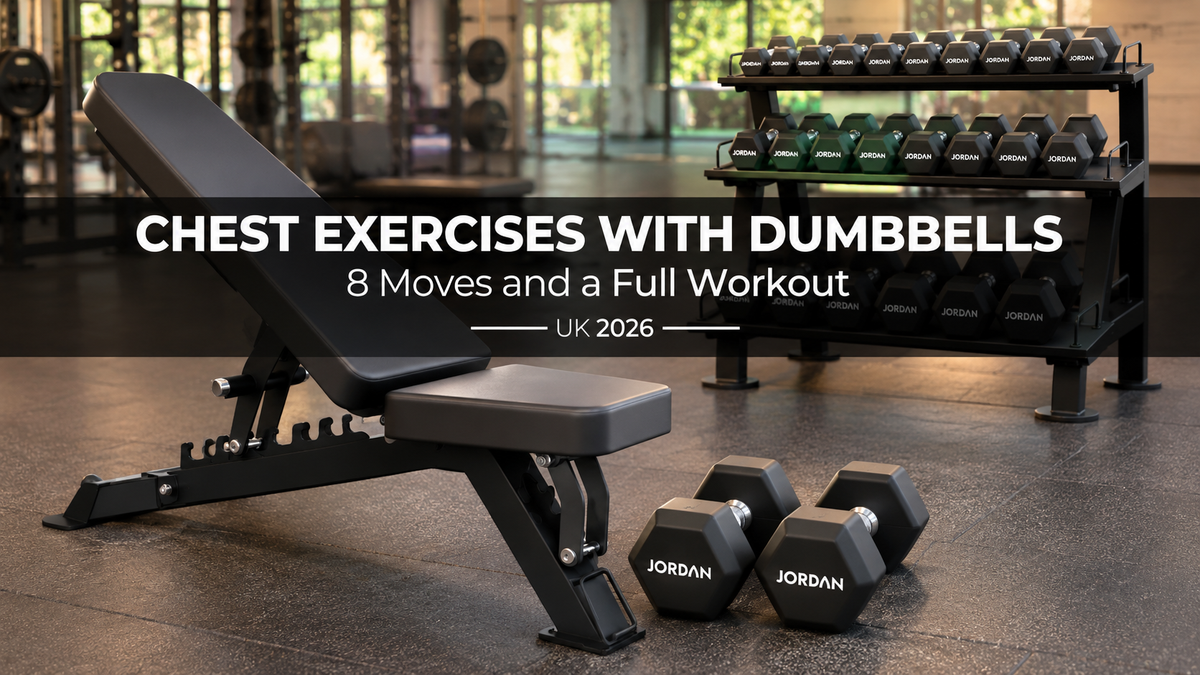
Chest Exercises with Dumbbells UK (2026): 8 Moves and a Full Workout

The best chest exercises with dumbbells are the flat dumbbell bench press, the incline dumbbell press, the dumbbell floor press, the dumbbell fly, the incline fly, the squeeze press and the dumbbell pullover, finished with push-ups. Together they train the upper, middle and lower chest, so a few pairs of dumbbells and an adjustable bench can build a stronger chest at home.
The short answer: build each session around two presses, one flat and one on a low incline, then add a fly and a finisher. Do 2–4 sets of each, two days a week. Set the incline to about 30°: a 2020 study found that angle gave the most upper-chest activity, while the flat bench worked the middle and lower chest hardest.
Key takeaways
- Press on a flat bench and a low incline. A 2020 study of 30 trained adults found the upper chest worked hardest at a 30° incline and the middle and lower chest worked hardest on a flat bench.
- You do not need a decline bench. In the same study, which tested flat to 60°, the lower chest was most active flat, so the flat dumbbell press already covers it.
- Presses come first, flys second. A 2020 study found the barbell bench press produced 16% more chest activity than dumbbell flyes at the same relative effort, so flys work best as a second exercise.
- The NHS asks adults to strengthen all major muscle groups, chest included, on at least 2 days a week. A ukactive report in January 2026 found 43% of UK adults do not meet that guideline.
What are the best chest exercises with dumbbells?
These eight moves cover the whole chest. The table shows what each one emphasises, what you need and a starting rep range.
| Exercise | Main emphasis | Equipment | Reps per set |
|---|---|---|---|
| Flat dumbbell bench press | Middle and lower chest, plus triceps | Pair of dumbbells, flat or adjustable bench | 6–10 |
| Incline dumbbell press (about 30°) | Upper chest and front shoulders | Pair of dumbbells, adjustable bench | 8–10 |
| Dumbbell floor press | Middle chest and triceps, shorter range | Pair of dumbbells, no bench | 8–12 |
| Dumbbell fly | Middle chest, in a stretched position | Lighter pair, flat bench | 10–15 |
| Incline dumbbell fly | Upper chest, in a stretched position | Lighter pair, adjustable bench | 10–15 |
| Squeeze press | Inner chest and triceps | Pair of hex dumbbells, flat bench or floor | 10–15 |
| Dumbbell pullover | Chest and lats together | One dumbbell, flat bench | 10–15 |
| Push-up (finisher) | Whole chest, body weight | None, or hex dumbbells as handles | As many good reps as you can |
Pick three or four moves per session, heaviest press first.
Which part of the chest do chest exercises with dumbbells work?
The chest muscle, the pectoralis major, has an upper (clavicular) part and larger middle and lower parts. They all press your arms forward, but the bench angle changes which part does the most work.
Researchers at the University of Almería measured this in 30 trained adults pressing at five bench angles. In Rodríguez-Ridao and colleagues' 2020 study, upper-chest activity peaked at a 30° incline, while the middle and lower chest were most active at 0° and dropped as the bench rose.
Front-shoulder activity rose with the angle and peaked at 60°, so a steep incline becomes more of a shoulder press. The study used a barbell and measured muscle activity, not growth, but the angles carry over to dumbbells.
How do you do a dumbbell bench press?
Sit on the end of a flat bench with a dumbbell on each thigh. Lie back and bring the dumbbells up beside your chest, then press them up over your shoulders.
Keep your feet flat and your shoulder blades pulled back into the bench. Lower the dumbbells until your elbows sit just below the bench line, at roughly 45° from your body, then press back up.
Dumbbells let each arm work on its own, so a weaker side cannot hide, and they allow a deeper stretch than a barbell.

How do you do an incline dumbbell press for the upper chest?
Set an adjustable bench to a low incline of about 30°. Press the dumbbells from the top of your chest up over your eyes, then lower them under control.
Keep the angle low: above about 45° your front shoulders take over, so if you feel it mostly there, drop the backrest a notch.
Are dumbbell flys worth doing?
Yes, as a second exercise after a press. Flys train the chest stretched, with much lighter dumbbells.
A 2020 study in the Journal of Sports Science and Medicine by researchers at Western Norway University compared the barbell bench press with dumbbell flyes in 17 trained men lifting their 6-rep maximum. The bench press produced 16% more chest activity on average, using about 88kg against 41kg for the flyes.
So press first for load, then fly for stretch. Lie on a bench with the dumbbells above your chest and elbows slightly bent, open your arms in a wide arc until you feel a stretch, then bring them back together. The incline fly does the same on a low incline.

How do you do the squeeze press, floor press and pullover?
For the squeeze press, press two hex dumbbells held together, palms facing, squeezing them hard throughout. The flat hex sides sit flush without rolling apart.
For the floor press, press lying on the floor with knees bent. Your upper arms stop on the floor, a good option with no bench or sore shoulders.
For the pullover, lie on a flat bench holding one dumbbell above your chest, lower it behind your head with slightly bent arms, then pull it back.
What does a full dumbbell chest workout look like?
A good dumbbell chest workout uses one flat press, one incline press, one fly and one finisher. Rest 90 seconds to 2 minutes between press sets and 60–90 seconds between the rest.
| Beginner (no bench) | Intermediate (adjustable bench) | |
|---|---|---|
| 1 | Dumbbell floor press, 3 × 8–12 | Flat dumbbell bench press, 3–4 × 6–10 |
| 2 | Squeeze press on the floor, 2 × 12 | Incline dumbbell press at about 30°, 3 × 8–10 |
| 3 | Floor fly with light dumbbells, 2 × 12–15 | Dumbbell fly or incline fly, 2–3 × 10–15 |
| 4 | Push-ups on knees or toes, 2 × as many good reps as you can | Dumbbell pullover, 2 × 12, then push-ups to finish |
Do this twice a week. The NHS physical activity guidelines ask adults to do strengthening activities on at least 2 days a week, working the legs, hips, back, abdomen, chest, shoulders and arms.
Many people fall short. The ukactive and Les Mills report Shaping a New Era of Strength Training, published in January 2026 from a poll of more than 4,000 UK adults, found that 43% do not meet the strength guidelines and 32% do no muscle-strengthening activity at all.
Pair it with our back exercises with dumbbells for a balanced week, and finish with moves from our tricep exercises with dumbbells guide.
How heavy should your dumbbells be for chest exercises?
Heavier for presses, much lighter for flys and pullovers. Choose a weight where the last two or three reps of each set are hard but your form holds.
Most people need three or four pairs: heavy for the flat press, the next pair down for the incline, and light for flys. Add weight when every set reaches the top of the rep range.
To get heavy dumbbells into position, rest them on your thighs and kick each knee up as you lie back.
Our guide to how heavy your dumbbells should be gives starting weights by exercise and experience.
What equipment do you need for a dumbbell chest workout at home?
An adjustable bench and three or four pairs of dumbbells cover all the chest exercises with dumbbells above. The bench matters most, because the angle decides which part of the chest you train.
The JORDAN HELIX Adjustable Weight Bench (£356) adjusts from flat to a steep incline, so it covers the flat press, the 30° incline press and both flys. The JORDAN Flat Bench (£510) has no incline and suits flat presses, flys and pullovers.
JORDAN HEX Dumbbells - Urethane are sold as single pairs from the 1kg pair at £13 to the 30kg pair at £329, or as sets from £708 for 1–10kg (10 pairs) to £2,084 for 2.5–30kg (12 pairs). The JORDAN Hex Rubber Dumbbell Set runs from £825 for 2.5–25kg (10 pairs) to £3,150 for 2.5–50kg (20 pairs).
A simple starting kit is the HELIX bench with 10kg, 15kg and 20kg urethane hex pairs: £864 at today's prices, with heavier pairs added one at a time.
| Setup | What it includes | Price | Best for |
|---|---|---|---|
| Starter | HELIX bench + 10kg, 15kg and 20kg urethane hex pairs | £864 | Building a chest routine, adding pairs over time |
| Full range | HELIX bench + Hex Rubber Dumbbell Set 2.5–25kg (10 pairs) | £1,181 | Every move here, light flys to heavy presses |
| Heavy range | HELIX bench + Hex Rubber Dumbbell Set 2.5–30kg (12 pairs) | £1,526 | Stronger lifters who press over 25kg per hand |


 JORDAN HEX Dumbbells - Urethane£13 – £2,084View product →
 JORDAN Hex Rubber Dumbbell Set£825 – £3,150View product →
Do you need a dumbbell rack?
Yes, once you own more than two or three pairs: you lift each pair from waist height, not the floor. The JORDAN 12 Pair, 3 Tier Hex Dumbbell Rack with Trays (£552) holds a full 12-pair hex set. JORDAN Vertical Dumbbell Racks (S-Series) (£420 – £768) fit a smaller footprint for fewer pairs.
 JORDAN 12 Pair, 3 Tier Hex Dumbbell Rack with Trays£552View product →
 JORDAN Vertical Dumbbell Racks (S-Series)£420 – £768View product →
See every format in our dumbbells collection, every bench in the benches range and every rack in dumbbell storage. Our weight bench buying guide explains flat versus adjustable, the hex dumbbells guide compares rubber, urethane and neoprene, and our guide to choosing a dumbbell set covers the other formats.
How is your equipment delivered?
Free UK delivery on the benches, the dumbbell sets and the racks above. Orders are dispatched within 5 working days, with tracking emailed within 24 hours of dispatch, and delivered across UK mainland by our delivery partners. We do not deliver to Northern Ireland.
Single dumbbell pairs often cost less than £250. Delivery is £20 on orders below £250 and free on orders of £250 or more, so a few pairs bought together often reach the threshold.
Setting up a chest and dumbbell area at home?
Tell us your space and the weights you press now, and we'll suggest the bench, pairs and rack that fit. Free UK mainland delivery on orders of £250 or more.
Shop dumbbells → Call 0333 880 3211on orders of £250 or more Commercial-grade kit
Jordan, Concept2, StairMaster Finance available
business & commercial Rated by UK buyers
read our reviews
Frequently asked questions
Can you build a big chest with just dumbbells? Yes. Flat and incline dumbbell presses can be loaded heavily, and flys and pullovers add work in a stretched position. Because each arm works on its own, dumbbells also even out a weaker side. Train chest twice a week and add weight or reps steadily.
Are dumbbells better than a barbell for chest? Neither is better in every way. A barbell lets you lift more total weight, while dumbbells give a deeper stretch, a freer path for your shoulders and no need for a spotter, because you can drop them to your sides if you fail a rep.
How do I target the upper chest with dumbbells? Use the incline dumbbell press and incline fly with the bench at about 30°. Research found that angle gave the most upper-chest activity, while steeper angles shifted the work onto the front of the shoulders.
Do I need a decline bench for the lower chest? No. In the 2020 bench-angle study, which tested flat to 60° inclines, the lower chest was most active on the flat bench, so the flat dumbbell press already trains it well.
Why do my shoulders hurt during dumbbell chest exercises? Usually your elbows are flared out to the sides, the bench is set too steep, or the weight is too heavy. Tuck your elbows to roughly 45°, keep your shoulder blades pulled back, lower the incline and use a lighter pair. If pain persists or comes with clicking or weakness, stop the exercise and speak to your GP or a physiotherapist.
How often should I train chest with dumbbells? Twice a week suits most people, with at least a day between sessions. Keep the second session lighter if it falls close to heavy shoulder or tricep work.
Get more guides like this
Join the Pro Gym Essentials list for equipment buying guides, workout guides and offers we don't publish on the site.
No spam. Unsubscribe any time.
Pro Gym Essentials — premium home and commercial gym equipment, delivered across UK mainland. Prices taken from our live product pages, 2 November 2026; activity guidelines from the NHS; participation figures from ukactive and Les Mills (January 2026); research from the International Journal of Environmental Research and Public Health (Rodríguez-Ridao et al., 2020) and the Journal of Sports Science and Medicine (Solstad et al., 2020). This article is general information, not medical advice.