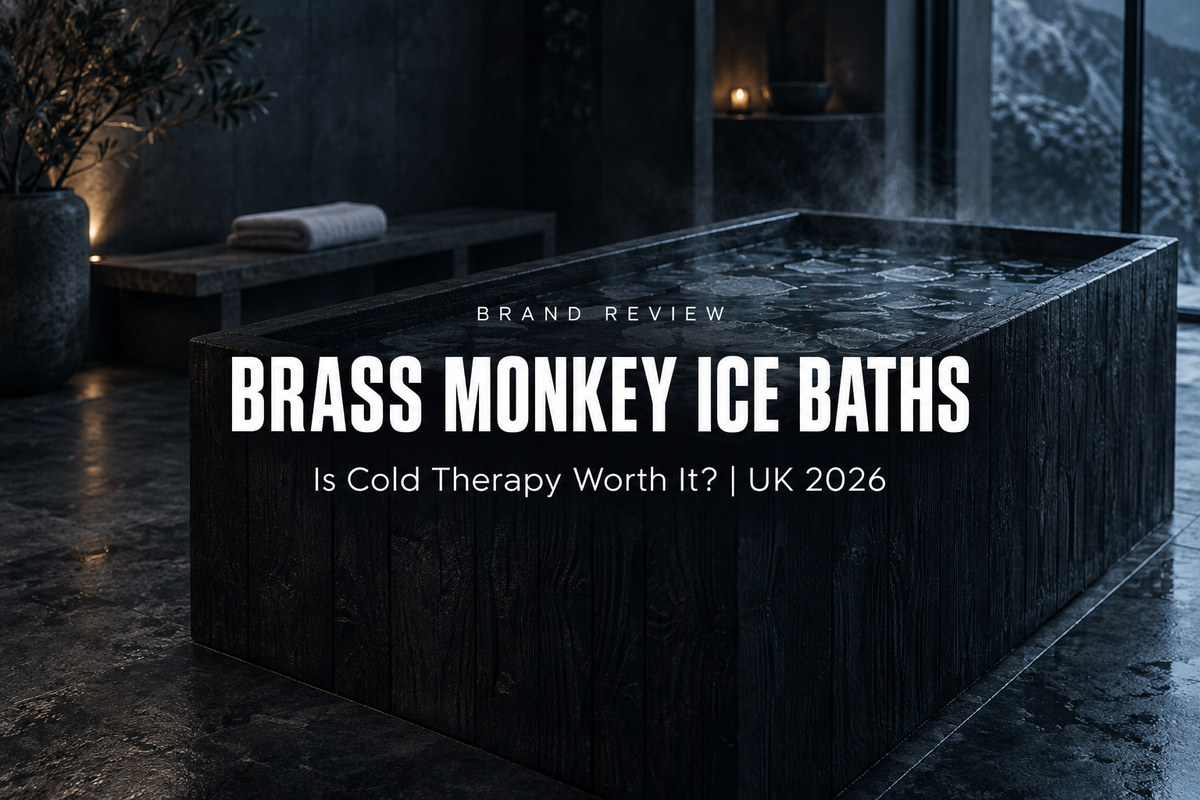
Cold therapy went from fringe to mainstream in about four years, and the gap between a £200 inflatable tub and a chiller-driven unit that holds 0°C on demand is now the single biggest source of confusion for UK buyers. Brass Monkey sits firmly at the serious end, and the questions worth asking are practical rather than philosophical.
The short answer: Brass Monkey's Ice Bath is a genuinely engineered, British-built cold plunge that holds a set temperature between 0 and 10°C and makes its own ice, rather than depending on you buying bags of it. It is worth it if you will use cold exposure several times a week and want it to be effortless; it is not worth it if you are testing whether you like cold water at all. It is a quote-only product — 27 size and finish combinations, and the spec conversation decides the order — so there is no shelf price here, and we would rather establish whether the thing fits your room before talking about money.
Key takeaways
Yes — and for once that is a meaningful differentiator rather than a marketing line. Brass Monkey Health was founded in 2021 by brothers Dan, Dale and Dean Bosomworth, after Dan converted a chest freezer in his garage into an ice bath following a Wim Hof cold exposure retreat. The company builds its units near Wetherby in West Yorkshire.
It has scaled quickly. As reported by Yahoo Finance UK in April 2025, the business employs around 50 people, anticipated a £7m turnover, took a seven-figure investment from Pitalia Capital, and supplies commercial clients including David Lloyd Clubs, Village Health & Wellness Club, and Arc, the contrast-therapy club at Canary Wharf.
Why this matters to a buyer rather than a journalist: a chiller-driven ice bath is a refrigeration appliance that lives in water. When something goes wrong — a filter, a pump, a control board — the difference between a UK manufacturer and a container-shipped import is the difference between a service visit and a shrug.
It holds a temperature, and it makes its own ice. The unit runs a variable 0–10°C range set from an app over WiFi, so the bath is at your number when you get in rather than at whatever the ice you tipped in last night has decided.
The ice-making is the genuinely unusual part. Brass Monkey's own FAQs explain that when the bath is set below 2°C, it freezes the bottom of the bath and releases it in cycles, creating “15-30mm ice sheets that break up easily.” Getting there is not instant: the same FAQ states the unit “can take up to 24 hours to get down to freezing temperatures” from a fresh fill.
The water is kept usable by a dual-stage system — a particle filter plus a UV filter — rather than by the chlorine you would put in a hot tub. That matters for skin, for smell, and for the steel components, and it changes the maintenance routine entirely.
Kit for this: if you are still deciding whether cold exposure is a habit or a phase, don't start here — start with cold showers for a month. The case for a chiller unit is that it removes every excuse, and that only pays back if you were going to use it.
There are three sizes — Standard, Compact and XL — and nine feature panel designs, which is 27 combinations in total. In practice the decision collapses into three questions.
| Decision | What actually settles it |
|---|---|
| Size | The user's height and the room's floor area, in that order. Measure the space with the 30cm airflow gap the unit needs on all sides — that clearance is not optional. |
| Cladding | Where it lives. Western Red Cedar and oak finishes suit a garden room or a visible wellness space; the uncladded option exists for plant rooms and back-of-house installs where nobody sees it. |
| Indoor or outdoor | The unit is rated for both, but outdoors needs the outdoor cover and a surface that will take the filled weight year-round — decking usually will not without checking. |
Panel options run from Coppered Oak and Burnt Cedar through the Herringbone range to Uncladded. Because the finish does not change what the machine does, pick the size first and treat cladding as a room decision.
This is the question that sinks more ice bath purchases than price does. Brass Monkey's own product specification gives the weight as 219kg empty and 739kg filled. That is roughly three-quarters of a tonne concentrated on a footprint smaller than a small car.
For almost every UK home that means a ground floor on a solid concrete slab — a garage, a utility room, a garden room with a proper base, or a patio. A suspended timber floor, a first-floor room, a loft conversion or a standard garden decking frame all need checking by someone qualified before the unit arrives, not after. Commercial mezzanines and converted upper floors need the same check and usually a structural engineer's sign-off.
The unit also needs a solid, level surface, not a level-ish one. A chiller sitting out of level is a service call waiting to happen.
Less than people expect, but the details are non-negotiable. Brass Monkey specifies a standard 230V supply within four metres, on an RCD-protected circuit with no extension cables. The plug should sit around a metre from the tub so splashes cannot reach it, and the unit should stay plugged in permanently — the FAQs are explicit that this keeps it earth-grounded at all times.
On running cost, the chiller is not on continuously. Brass Monkey states it runs approximately 20–25% of the day once the bath is at temperature, which is why holding a plunge cold is far cheaper than most people assume and far cheaper than repeatedly buying ice.
Two more practical requirements: a 30cm gap all round for airflow to the cooling equipment, and a hosepipe for filling, or an optional plumbed connection. The unit is IP44-rated and suitable for indoor or outdoor use with adequate ventilation.
The Ice Bath is quoted to your size, finish and install rather than listed. Send us your room, your floor construction and your nearest power supply, and we'll come back with a specification that will actually work — or tell you honestly if the space won't take it.
Request a quote → Call 0333 880 3211More modest than the marketing, and worth knowing before you spend four figures. The largest recent synthesis is Cain, Brinsley, Bennett, Nelson, Maher and Singh, “Effects of cold-water immersion on health and wellbeing: A systematic review and meta-analysis”, published in PLOS ONE in January 2025, covering 11 studies and 3,177 participants.
Its findings, plainly: cold-water immersion reduced stress, but only for about 12 hours after exposure. Participants taking 20, 60 or 90-second cold showers reported slightly higher quality-of-life scores, and those effects had faded by three months. One included study found a 29% reduction in sickness absence among regular cold-shower users. There were links to better sleep, but the data was male-only. On immunity and mood, the review found “very little evidence.”
One finding often reported backwards: cold-water immersion produces a temporary increase in inflammation, not a reduction. The researchers describe this as the body reacting to cold as a stressor, which is the mechanism behind any adaptation — but it is the opposite of the “reduces inflammation” claim you will see on a lot of product pages.
None of that makes an ice bath a bad purchase. It makes it a recovery and habit tool with real but bounded effects, which is a perfectly good reason to own one — and a bad reason to expect it to fix your immune system.
It can, if you time it badly, and this is the single most important caveat for anyone buying an ice bath to sit next to a rack. Roberts and colleagues, writing in The Journal of Physiology in 2015, reported that post-exercise cold water immersion attenuates acute anabolic signalling and long-term adaptations in muscle to strength training, compared with active recovery.
The practical reading is not “never plunge.” It is: keep cold immersion away from the hours immediately after a hypertrophy or strength session. Use it on rest days, before training, after conditioning or endurance work, or several hours clear of lifting. If your main goal this block is muscle and strength, do not finish every session in the bath.
If recovery in general is the gap in your training rather than cold specifically, our guide to the recovery habits most people ignore covers the cheaper levers first, and what cold therapy is and why athletes use it covers the background.
That there is now specific, named UK guidance, and an inspector will expect you to know it. The Pool Water Treatment Advisory Group published Technical Note 71, Ice Baths, in August 2024, reviewing “the health aspects as well as water quality considerations” of cold water immersion. It is written for commercial operators, and PWTAG states that domestic users “should follow these guidelines as closely as they can.”
Alongside it, the British & Irish Spa & Hot Tub Association's cold water immersion factsheet sets out the operational expectations a facility will be judged against: supervision rather than unsupervised access, non-slip surfaces and handrails, restrictions on under-16s, and clear exit triggers for staff to act on — excessive shivering, skin discolouration, slurred speech, chest pain or dizziness.
If you are specifying a plunge for a gym, studio or wellness suite, read both before you write the risk assessment, not after.
Routine, but light, and different from a hot tub. The particle filter is replaced monthly and the UV bulb every six months. Reusable filters are rinsed with a hosepipe and soaked in a chlorine solution — outside the bath, not in it. Brass Monkey recommends replacing the water roughly every six months depending on use.
The chemistry rule matters more than the schedule: Brass Monkey recommends Huwa-San TR3, a silver-stabilised hydrogen peroxide, or a food-grade 3% hydrogen peroxide, and advises against chlorine, bromine or other harsh chemicals in residential models. Treating a cold plunge like a hot tub is the most common and most expensive mistake, because those chemicals attack the steel components the chiller depends on.
How cold does the Brass Monkey Ice Bath actually get? It runs a variable 0–10°C, set from the app. Reaching freezing from a fresh fill can take up to 24 hours, and below 2°C the unit cycles to form 15–30mm ice sheets on the surface. Most users settle somewhere between 3°C and 8°C for regular sessions rather than running it at zero.
How much does a Brass Monkey ice bath cost? It is quoted rather than listed, because there are three sizes, nine cladding options and 27 combinations, and because access and installation vary enormously between a garage slab and a first-floor wellness suite. Send us your room, floor construction and power supply and we'll come back with a delivered specification and price.
Can I put an ice bath upstairs or on decking? Not without checking first. The filled weight is 739kg on a small footprint, which is a ground-floor, solid-slab decision in most UK homes. Suspended timber floors, first-floor rooms, loft conversions, mezzanines and standard garden decking all need assessing by someone qualified before delivery is booked.
Is it expensive to run? Less than most people expect. Brass Monkey states the chiller runs approximately 20–25% of the day once the bath is holding temperature, on a standard 230V supply. Holding water cold is considerably cheaper than repeatedly buying bagged ice, which is the comparison that usually matters.
Do I need a plumber or an electrician? Usually neither, but you do need the right socket. The requirement is a standard 230V supply within four metres on an RCD-protected circuit, with no extension cables, and the plug kept about a metre from the tub. Filling is by hosepipe, with an optional plumbed connection available. If your intended spot has no compliant socket, an electrician is the one trade you will need.
Can I use chlorine in it like a hot tub? No — and this is the mistake that causes the most damage. Brass Monkey advises against chlorine, bromine and other harsh chemicals in residential models because they attack the steel components, and recommends Huwa-San TR3 or food-grade 3% hydrogen peroxide instead, alongside the particle and UV filtration.
Is cold water immersion safe for everyone? No. Cold water causes an immediate, involuntary response in the body, and UK industry guidance for commercial operators recommends supervision, bars under-16s without medical supervision, and lists exit triggers including chest pain, dizziness, slurred speech and excessive shivering. Anyone with a heart condition, high blood pressure, circulatory problems, or who is pregnant should speak to their doctor before starting cold water immersion at all.
Get more guides like this
Join the Pro Gym Essentials list for equipment buying guides, spec comparisons and offers we don't publish on the site.
No spam. Unsubscribe any time.
Pro Gym Essentials — premium home and commercial gym equipment, delivered across the UK. Specifications verified 15 September 2026. This article is general information, not medical advice.